Eco-Schools’ history
Since 1994, Eco-Schools has developed from a European educational programme to a global model for environmental education and sustainability at the international level.
Timeline
1992: Programme Development
Eco-Schools was developed in response to the call to action made at the United Nations Earth Summit.
1994: First Countries Join
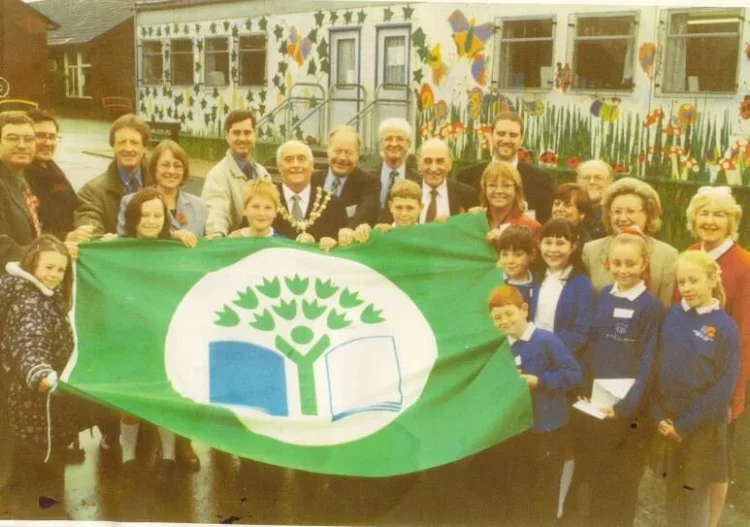
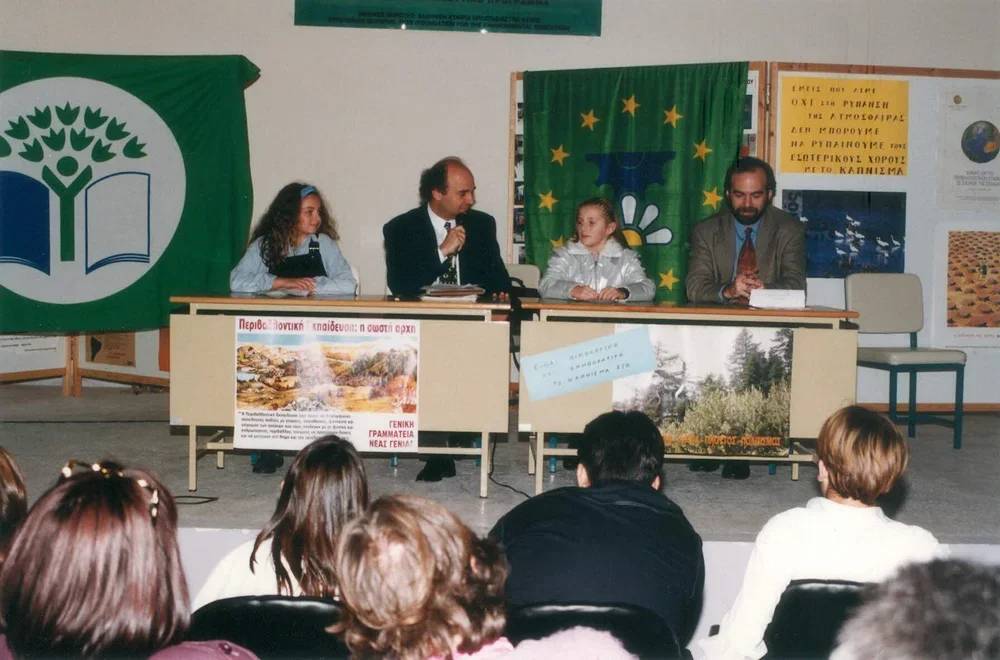
Denmark, Germany, Greece and the United Kingdom became the first adopters of Eco-Schools, with support from the European Commission.
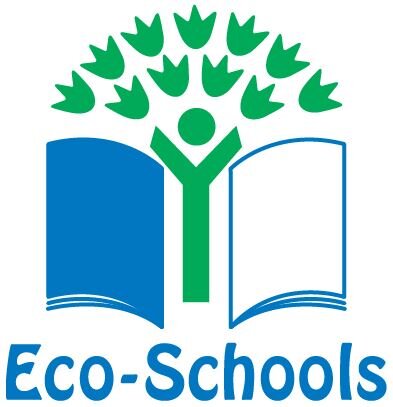
When the programme was launched in 1994, it ran a logo competition for Eco-Schools, for an image that would visualise environmental school education and student involvement. The winning entry formed today’s logo with people as the centre of the programme, who are responsible for greening the future. This is symbolised by the flowers growing from the central person’s arms. The flowers symbolise both the environment that shelters and protects humans, as well as the knowledge gained by students who participate in the programme and whose actions help develop values, attitudes and behaviour towards the environment. The book in the logo represents schools and knowledge, with two different pages; the blue page represents the past, the history that one needs to familiarise with and the problems in society already created and need to be dealt with. The white page represents the future, a blank page to be filled with new knowledge and innovative experiences.
1999 — Global Education Recognition
Eco-Schools received the Worldaware Award for Global Education from the North-South Centre of the Council of Europe and the National Committee for International Cooperation and Sustainable Development (NCDO).
2002 — Partnership with UNEP
FEE and the United Nations Environment Programme (UNEP) organised a workshop on Eco-Schools partnerships for Africa, expanding the programme’s reach and strengthening equity and inclusivity.
2003 — Education for Sustainable Development Recognition
UNEP recognised FEE as a model initiative for Education for Sustainable Development.
2004 — 10-Year Milestone
After a decade of action, Eco-Schools reached:
Over 4 million students
200,000 teachers
12,000 schools
16,000 training sessions
Nearly 1,700 local authorities
National Operators were active in implementing the programme locally.
2005 — Environment and Innovation Project
FEE launched the Environment and Innovation Project with support from Toyota Fund for Europe.
The first cycle focused on Sustainable Mobility and included participation from Italy, Germany, Spain, England and Northern Ireland.
2007 — Quality, Standardisation and Flexibility Study
The Eco-Schools International programme study was launched across 15 countries: China, Cyprus, the Czech Republic, Denmark, England, Greece, Italy, Ireland, Malta, Norway, Scotland, Slovakia, Slovenia, South Africa and Wales.
2008 — Climate Change Campaign and Partnerships
The second cycle of the Environment and Innovation Project, themed Climate Change: Let's Save Energy!, was launched with support from Toyota.
A partnership was established with the World Future Council (WFC) to promote and implement the KidsCall campaign, advocating for children’s rights to a just and secure world.
2009 — HSBC Eco-Schools Climate Initiative
A three-year global project was launched to empower students to contribute to reducing carbon emissions.
Participating countries included Brazil, China, England, Ireland, Japan, Jordan, Malta, Russia, Slovakia, South Africa, the United States and Wales.
2010 — Litter Less Campaign and UNESCO Partnership
Eco-Schools and Young Reporters for the Environment received major sponsorship from the Wrigley Company Foundation for a three-year Litter Less Campaign.
FEE also formalised its relationship with UNESCO.
2011 — Eco-Schools Connect and Global Participation
Eco-Schools launched Connect to map participating schools and strengthen global networking.
By the end of the year, more than 11 million students across 52 countries were participating.
Eco-Schools signed a Memorandum of Understanding with the Earth Charter.
2012 — Global Action Days
Eco-Schools launched the Global Action Days programme.
2013 — World Days of Action
263 schools and 117,561 teachers and students from 10 countries participated in World Days of Action events.
2014 — Global Expansion
Eco-Schools launched in India, Ghana and Australia.
The Litter Less Campaign entered a new three-year cycle involving 22 Eco-Schools countries and 5 Young Reporters for the Environment countries, with a budget of USD 3.7 million.
In 2014, the Eco-Schools programme celebrates its 20-year anniversary and an International Conference took place in Cardiff in December 2014
2015 — Regional and International Expansion
The Indian Ocean Commission launched Eco-Schools as a regional programme covering Madagascar, Comoros, Mauritius, Rodrigues, Seychelles and Zanzibar.
FEE also launched Eco-Schools for International Schools, allowing participation in countries without a National Operator.
In 2015, FEE Board member, Laura Hickey, and Keep Northern Ireland Eco-Schools Project Officer, Ruth Van Ry, spoke about the Eco-Schools programme and visited Lagan College (01:32 - 09:42).
Daniel Schaffer, FEE’s CEO, visited Fairview Primary School in Northern Ireland during the Eco-Schools NOM. Click here to watch the BBC coverage.
Eco-Schools Indian Ocean
Eco-Schools Northern Ireland
2016 — Waste-Water-Watts (W3) Pilot
Eco-Schools entered a pilot year project with the Alcoa Foundation on Waste-Water-Watts (Alcoa W3), a global K–12 environmental literacy initiative focused on Green STEM.
2017 — Record Participation and Twinning
Eco-Schools reached 19 million students globally.
Eco-Schools Twinning was launched by the National Operator in England, enabling schools to partner internationally.
2018 — 25th Anniversary

Eco-Schools celebrated 25 years and committed to expanding from 68 countries to every country in the world.
2019 — Programme recognition
HundrED.org Sustainability Spotlight 2019. Eco-Schools was recognised as one of the world’s Top10 innovations in Education for 2019!
2020 — #EcoSchoolsStayActive
The #EcoSchoolsStayActive campaign was launched to support student engagement during COVID-19 lockdowns.
2021— Eco-Schools celebrated the 10th anniversary of the Litter Less Campaign.
4 million students around the world were involved in the Litter Less Campaign in the course of a decade.
2023 — Co-coordinating the Greening Education Partnership
FEE joined UNESCO as coordinator the Greening Education Partnership’s Greening Schools pillar – committing to support its members in achieving the ambitious target to Green 50% of the world’s schools by 2030.
2024 — Programme Growth
After thirty years of programme growth, Eco-Schools International had reached:
Almost 50,000 schools
183 Higher Education institutions
75 countries via members and a further 23 countries via international schools