A Nature Trail Full of Compassion
Vanse Primary School, Norway
The Covid-19 restrictions forced many schools to adapt and be creative. At Vanse Primary School in Norway, teachers came up with an idea to help students learn about biodiversity. They decided to create a path in the local forest to motivate students to take walks and learn about sustainability and environmental protection along the way.
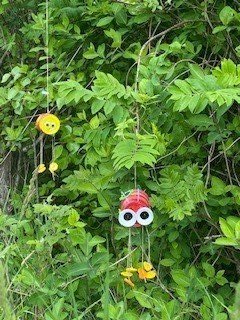
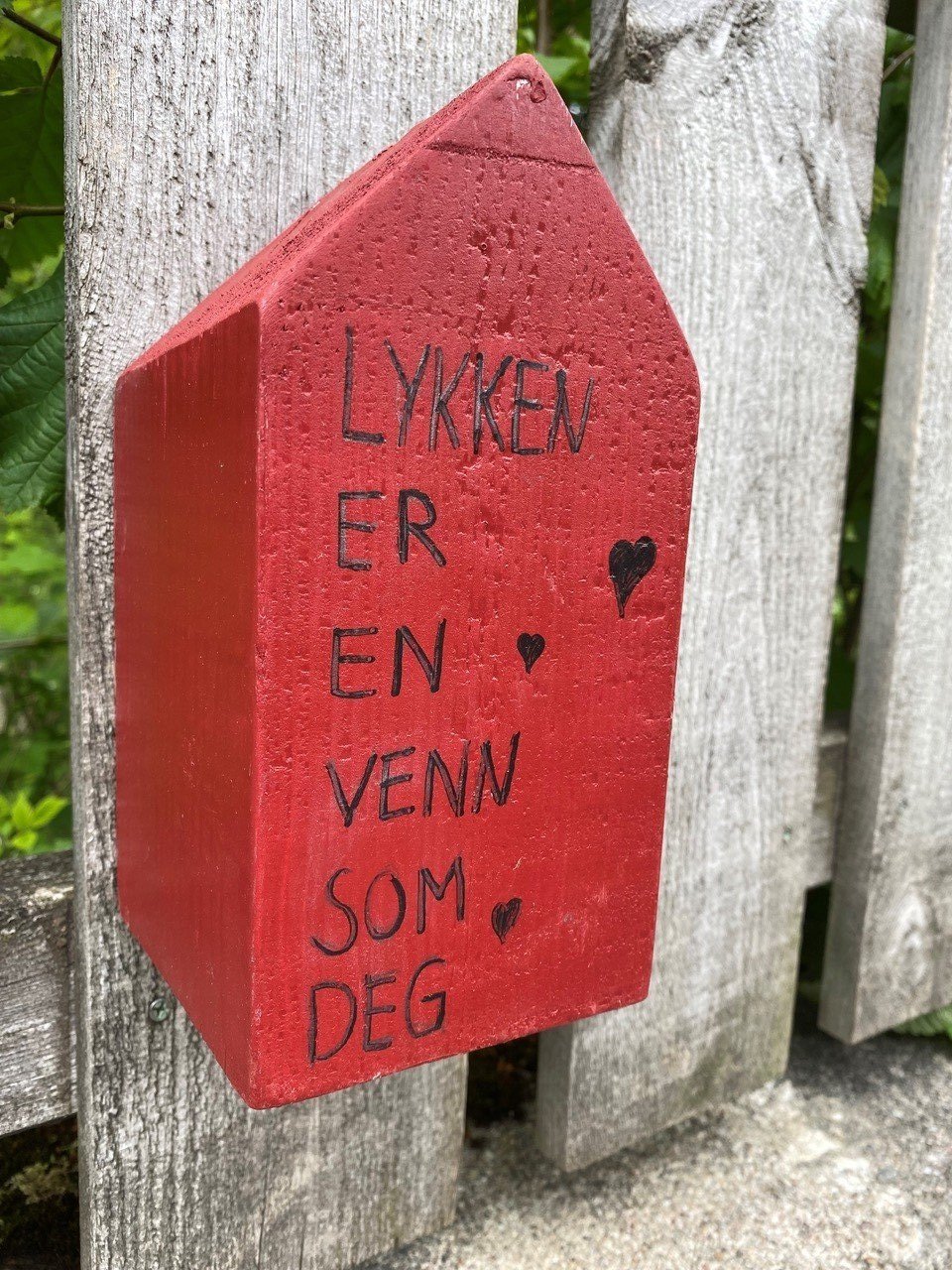
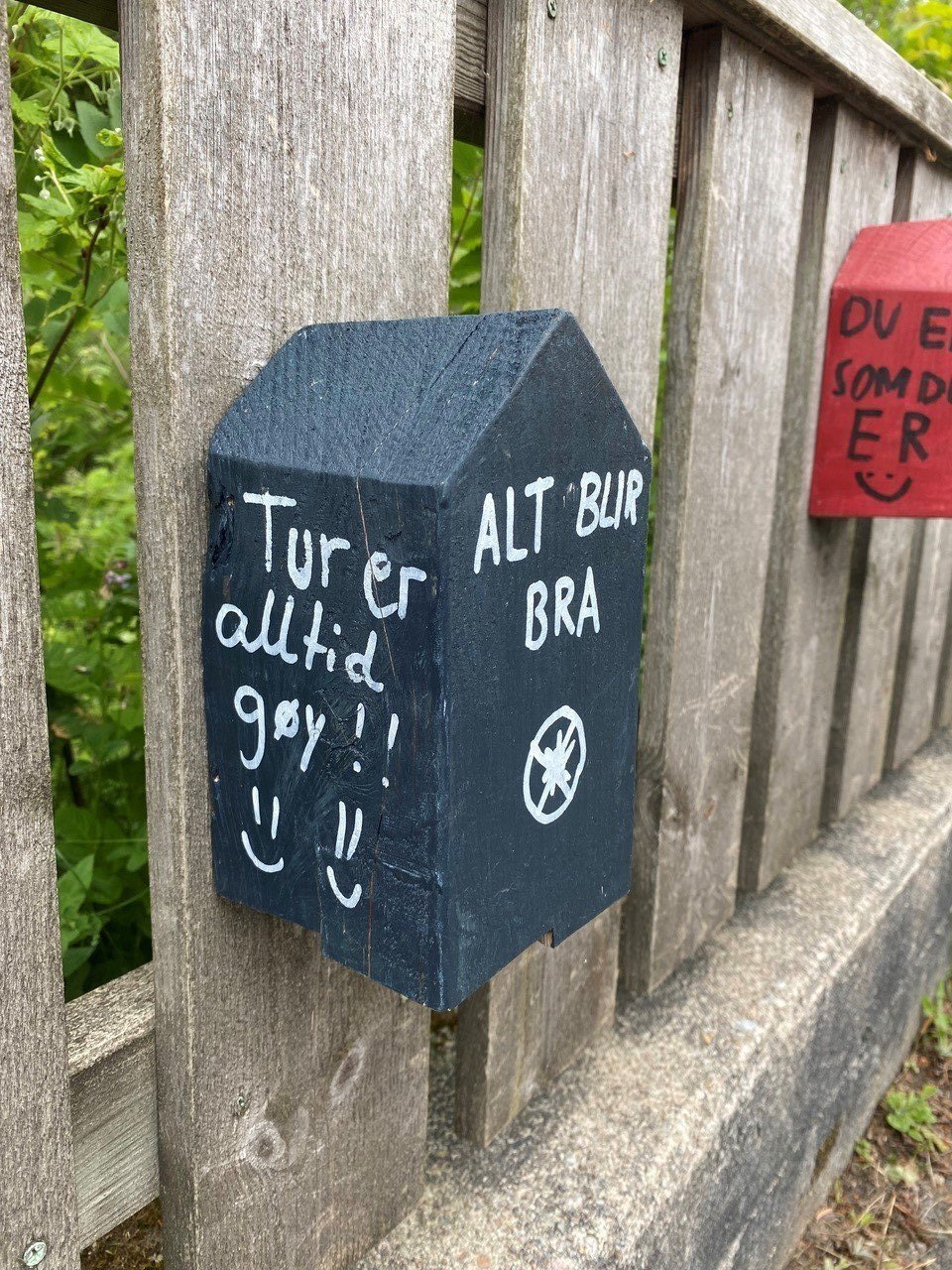
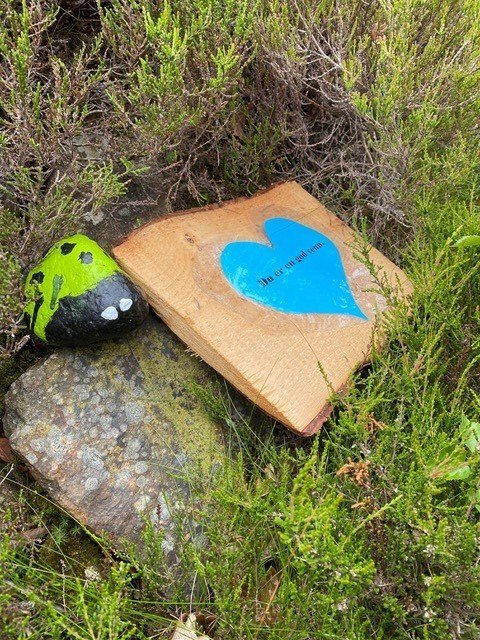
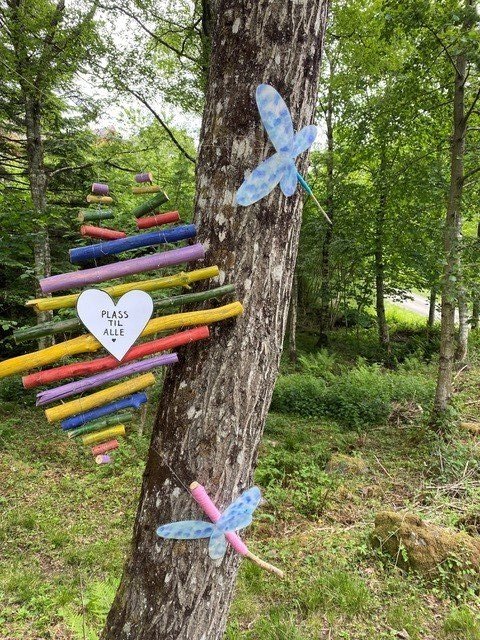
The school developed a nature trail in a nearby forest and called it “The Path of Joy in Nature”. Along the trail, students and teachers wrote encouraging messages to each other on wooden signs and stones. With this experience, they wanted everyone to feel closer to nature, to each other, and to themselves. Some students also made insect hotels for the path and art from natural materials. In this process, they learned about different species and how to protect them. The students brought their parents on the path after school and on the weekends. Other locals also enjoyed it and it was made accessible for wheelchairs and prams.
“When the students weren’t allowed to gather in big groups, we came up with the idea that if everyone walked the same path and looked at the same things, they could share an experience and feel like they were doing something together although they could not meet.” Monica Torp Rullestad, teacher.
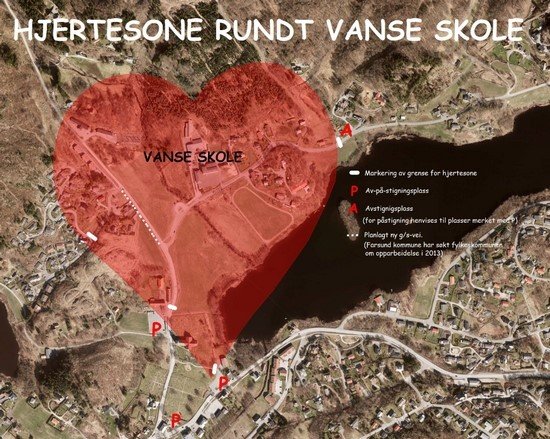
Another initiative the school developed was to encourage walking to go to school. They made a “heart zone” around the school yard where no cars were allowed to drive. This helped keep the school yard safe and, at the same time, encouraged students to start the day with a short walk for their physical and mental health. In this context, students also learned about sustainable means of transportation and concrete actions to reduce carbon emissions.
Recycling was also a topic the school wanted to improve. They already had recycling bins, so the focus was more on informing the students about why and how to recycle. As part of the school, there is a dedicated room where everything (including batteries and lightbulbs) can be recycled and where the containers can be emptied. This project allowed them to collaborate even more closely with the cleaning staff.
Overall, these initiatives taught the students how to be kind to themselves and to each other - in a world where it is more than important to act together.
The Alcoa W5 project of Vanse Primary School support the following SDGs:
Calculating Carbon Footprints
Madison Elementary School, USA
Capital projects can be very beneficial for a school district. Upgrades in things like technology, safety, and infrastructure are so important, but there can be drawbacks too. Through the W5 project, the 6th graders at Madison Elementary School in Massena, NY learned a lot about climate change and the role of the construction industry this year.
The Massena Central School District is going through a three-year capital project. Major renovations are underway at Madison Elementary. The 6th graders saw dozens of extra vehicles in the parking lots and around the school, along with cranes and numerous other pieces of heavy equipment on-site every day for the last two years. The children decided to work on the theme of Climate Change and to learn about how their everyday activities, as well as construction, can affect the climate and local environment.
The students initially learned about the effects of climate change around the planet and were in awe. Then they studied the data on their own town’s monthly average temperatures and precipitation amounts for the last 150 years. They graphed this data and learned that winters are becoming much milder while summers are becoming much dryer in Northern New York. Climate change is not just affecting far-away places, it is affecting their community too.
Due to the construction going on at their school this year, the entire 6th grade spent the 1st semester learning all together in the school’s cafeteria and the 2nd semester in the gymnasium. They listened to drills, saws and jack hammers every day. This situation prompted the children to investigate how construction can add greenhouse gases to the atmosphere. They calculated their own and their families’ carbon footprints to compare with the average footprint. They learned that the United Nations’ goal is for every human to produce only two tons of carbon dioxide each year, but their carbon footprints were much higher than that.
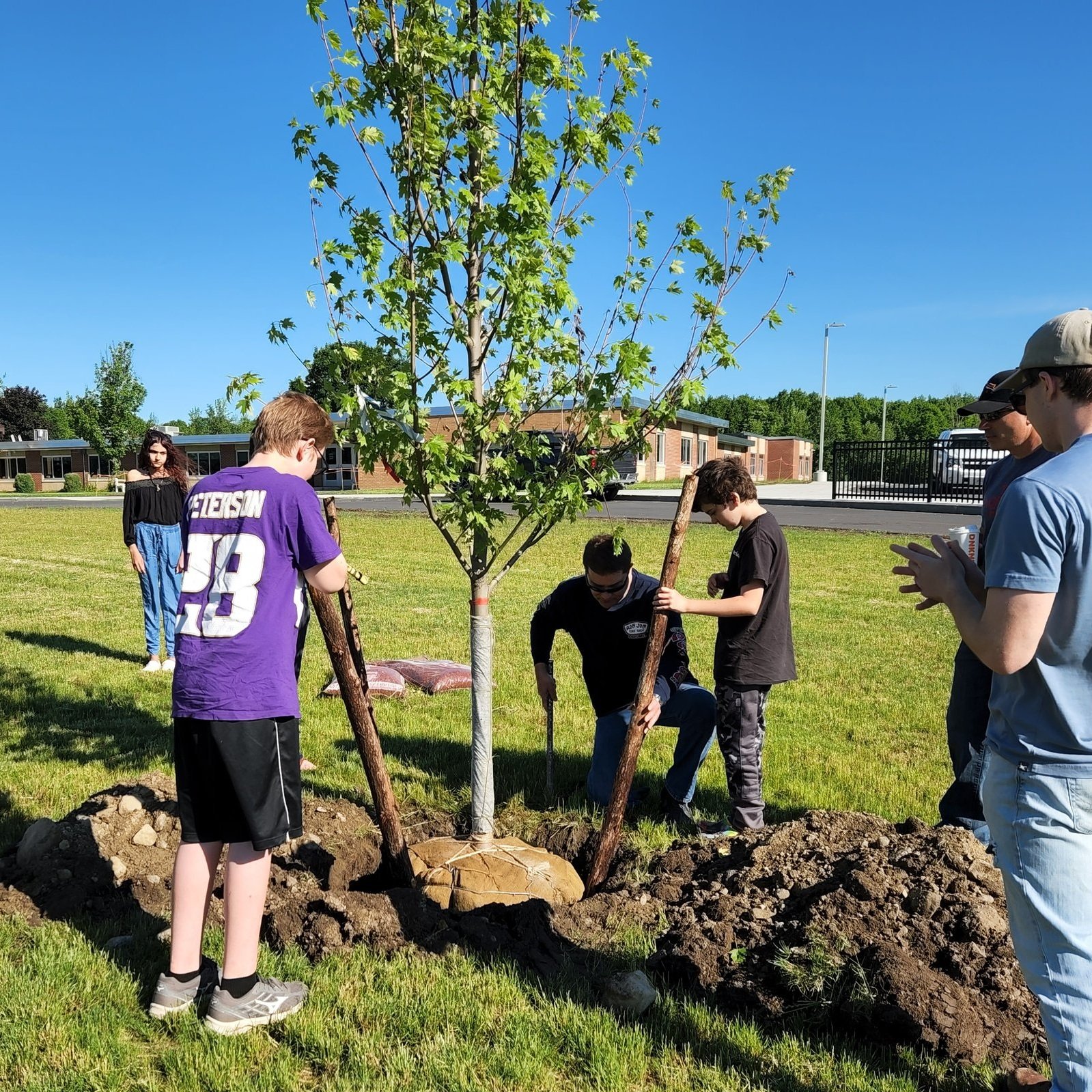
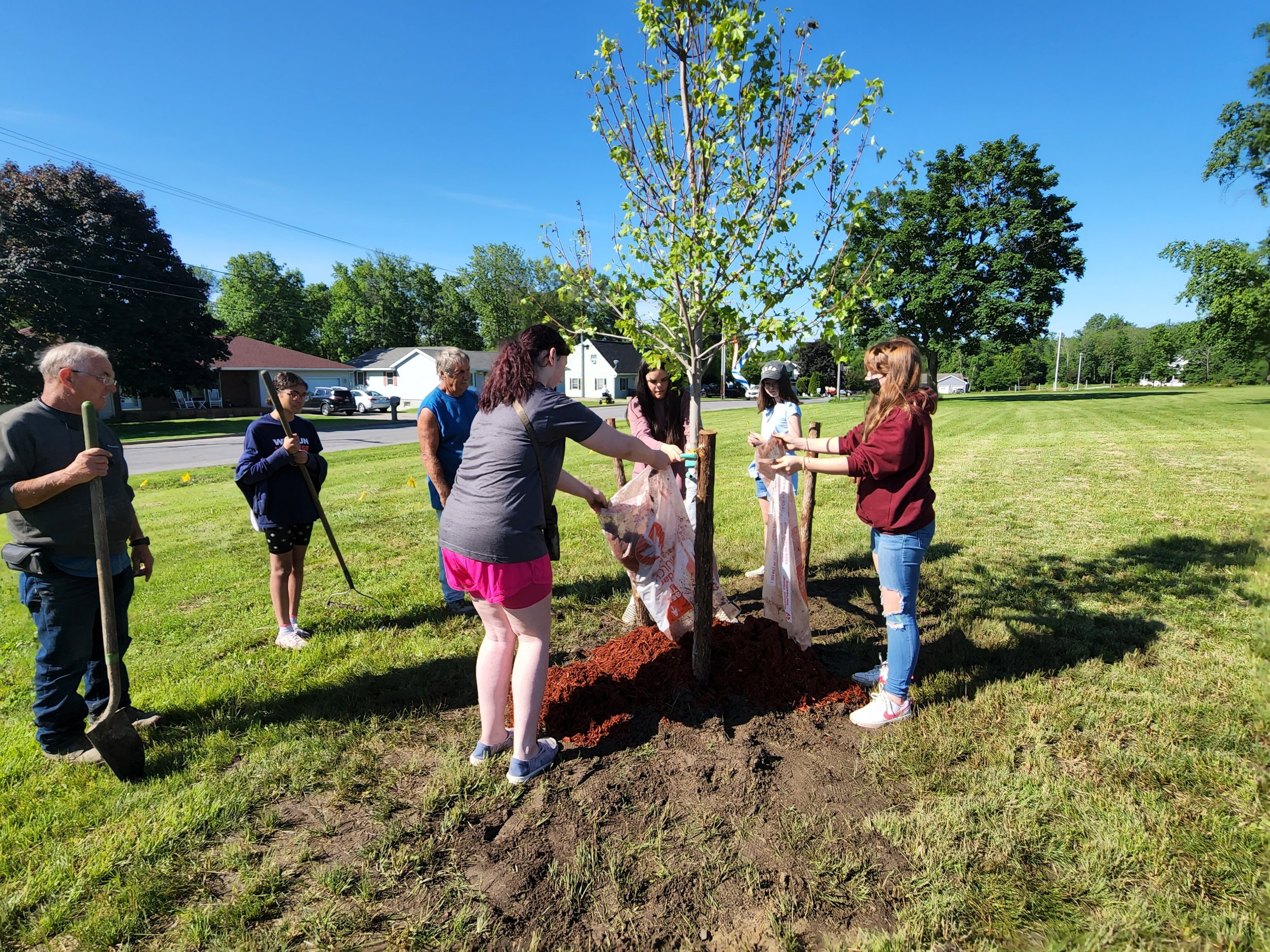
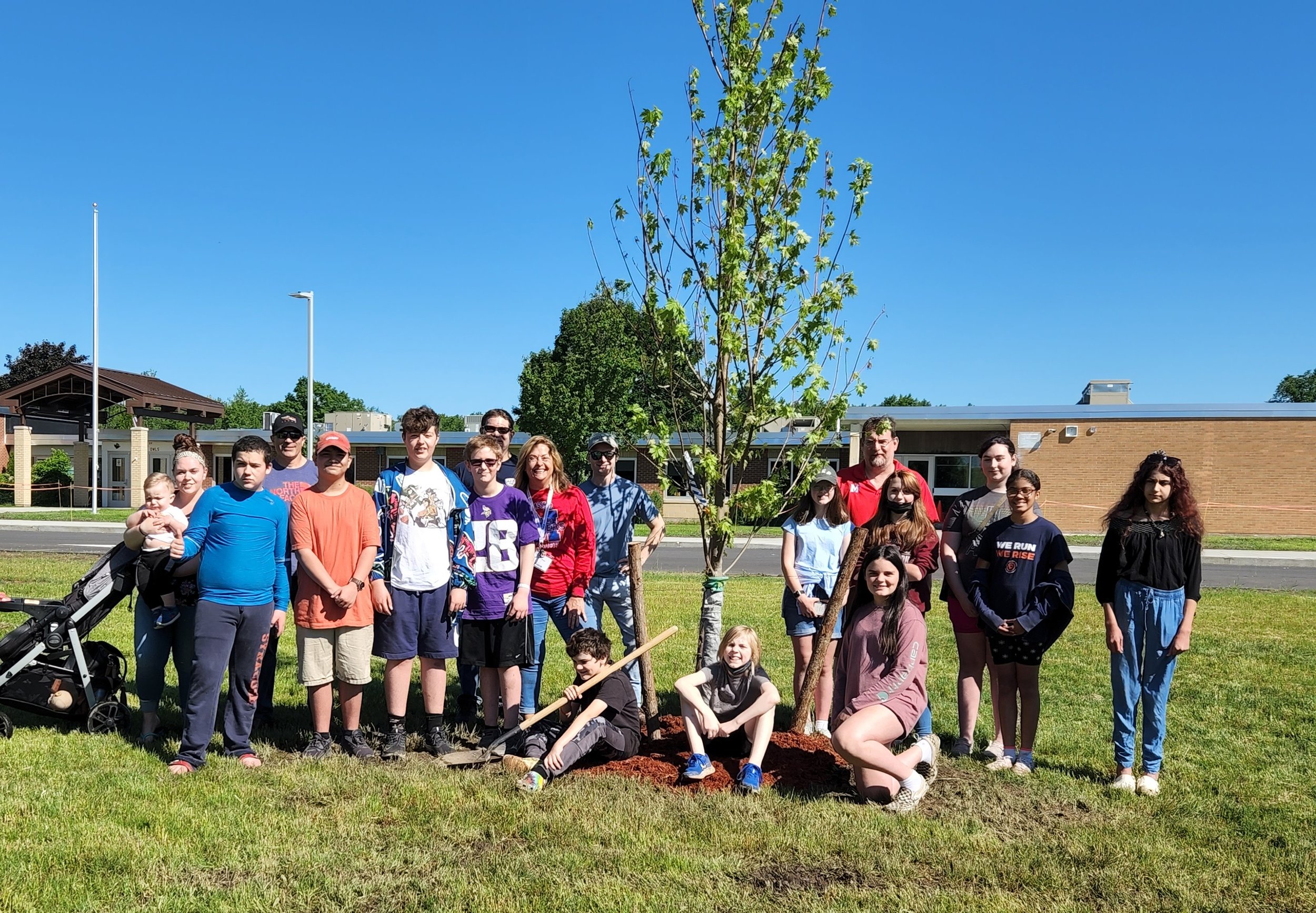
With the knowledge of how much CO2 everyone was producing and how much all the construction-related vehicles and equipment at their school were adding to the environment, the students researched ways to make small changes that could reduce their carbon footprint. If many people all made these small changes, it could have very positive effects on the environment. They created carbon footprint posters and displayed them around the school to teach all the other students these simple changes everyone can take. Moreover, they worked with several other students to plant maple trees around the school. They indeed learned that trees are great carbon sinks, and that maple trees over the course of their lives can absorb and store a lot of carbon, as well as clean the air and provide shade and beauty for decades!
The Alcoa W5 project activities at Madison Elementary School support the following SDGs:
Using the School Pond as a Learning Site
Boonville High School, USA
For the Alcoa W5 project, students from the Boonville High School in the United States decided to renovate the most enjoyed and admired feature of their schoolyard, the pond!
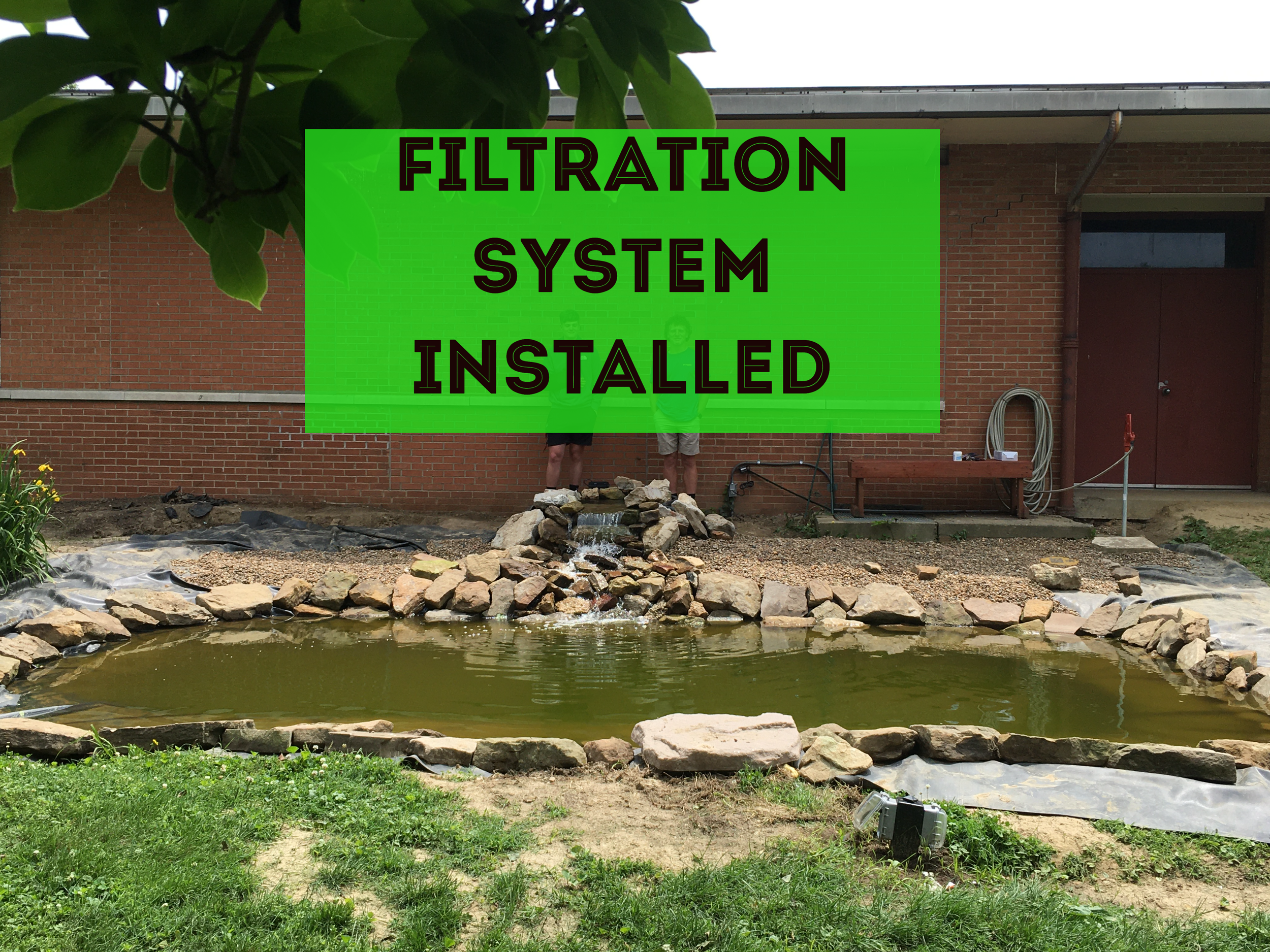
To renovate the pond, the high schoolers decided to upgrade it and improve its surrounding areas. The old pond was not holding water adequately and the filtration system was not thoroughly cleaning the water. To fix this, the students decided to include biofiltering in the pond and to put a new liner and skimmer. A handyman was employed to install the plumbing and electric. The students also used rocks to construct a waterfall and to finish out the edging of the pond.
“I enjoyed collaborating with the teacher and watching her interact with her students on this project. The students were very polite and helpful. I was very satisfied with the finished project” - Handyman who installed the pond’s filtration system.
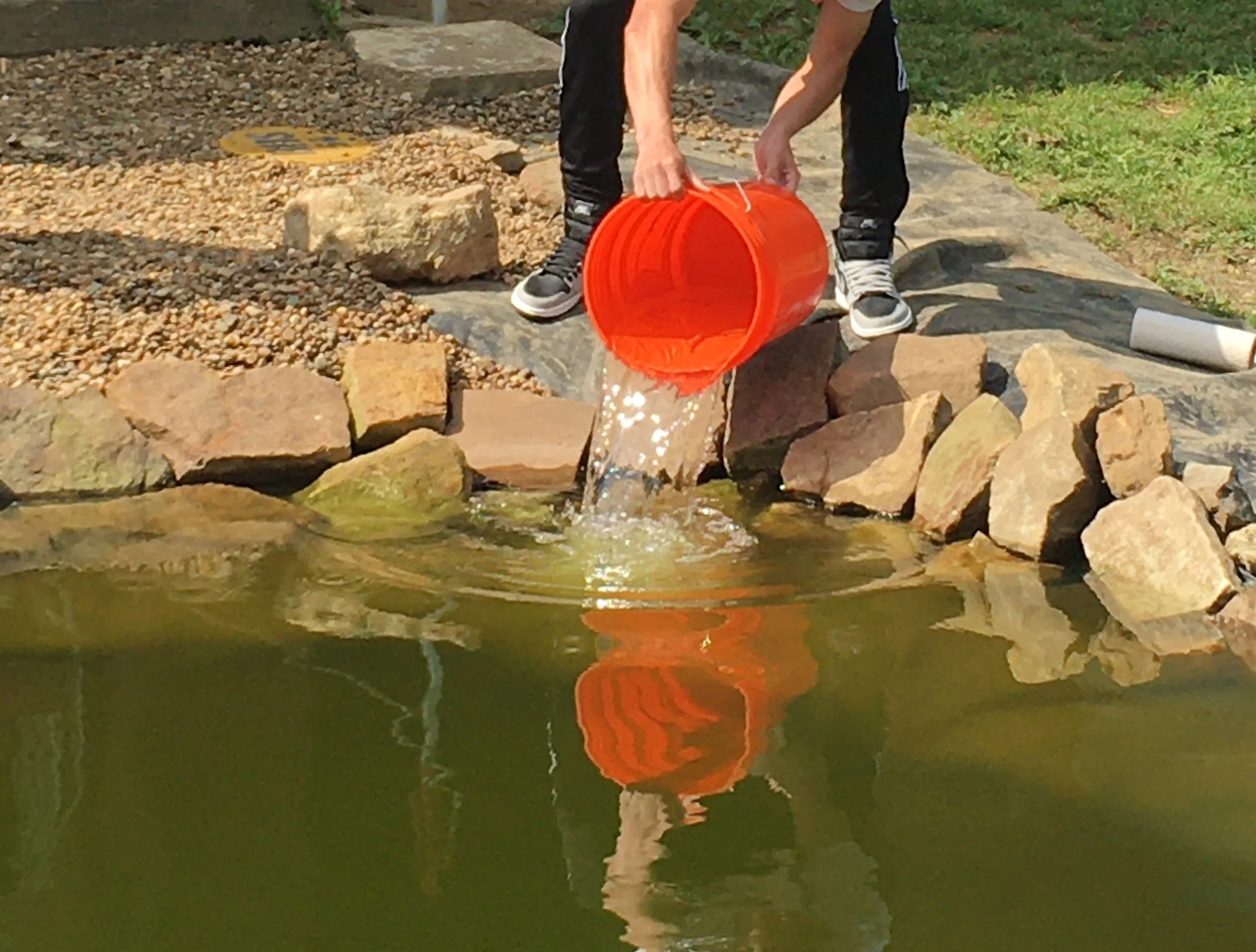
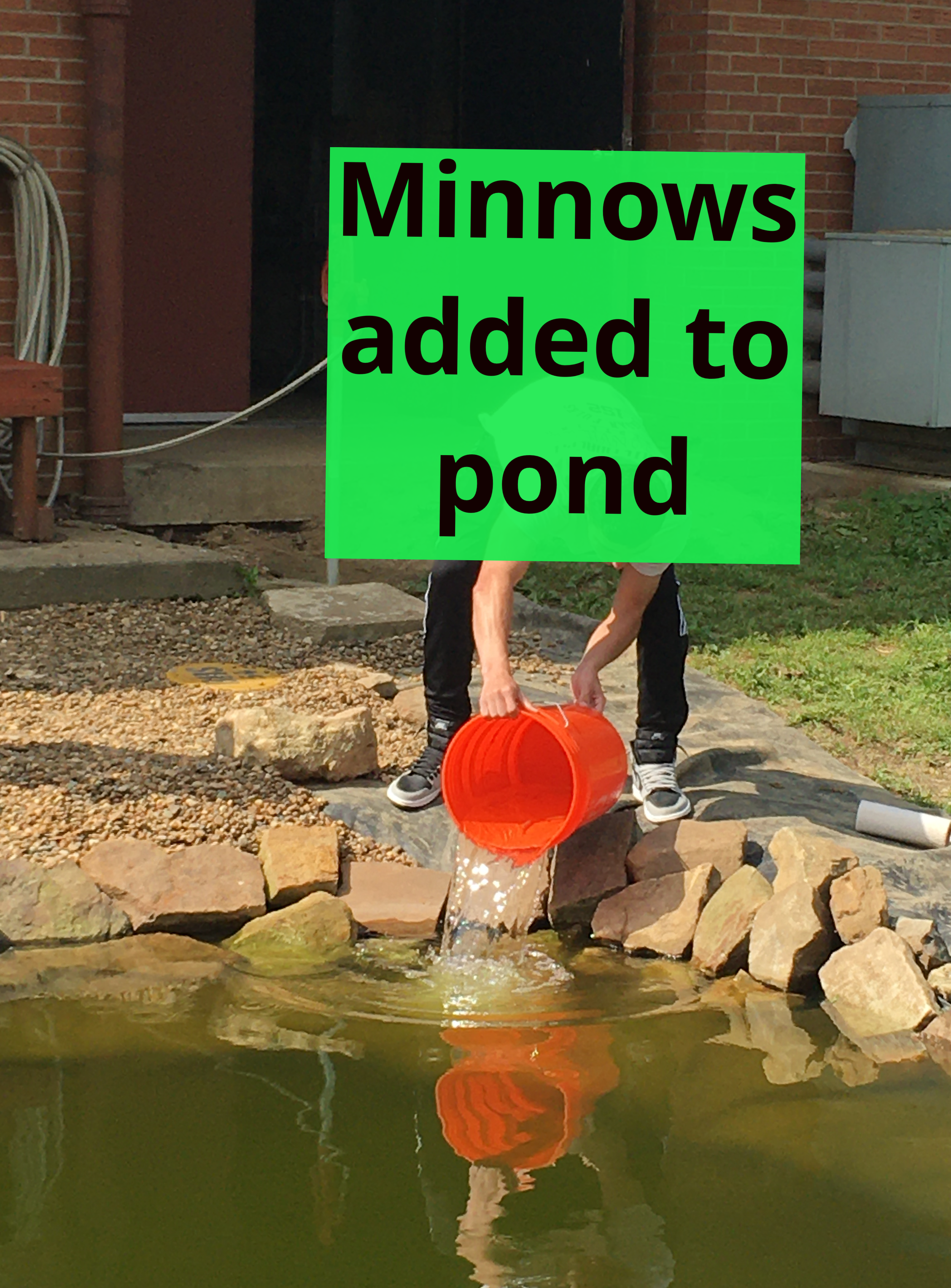
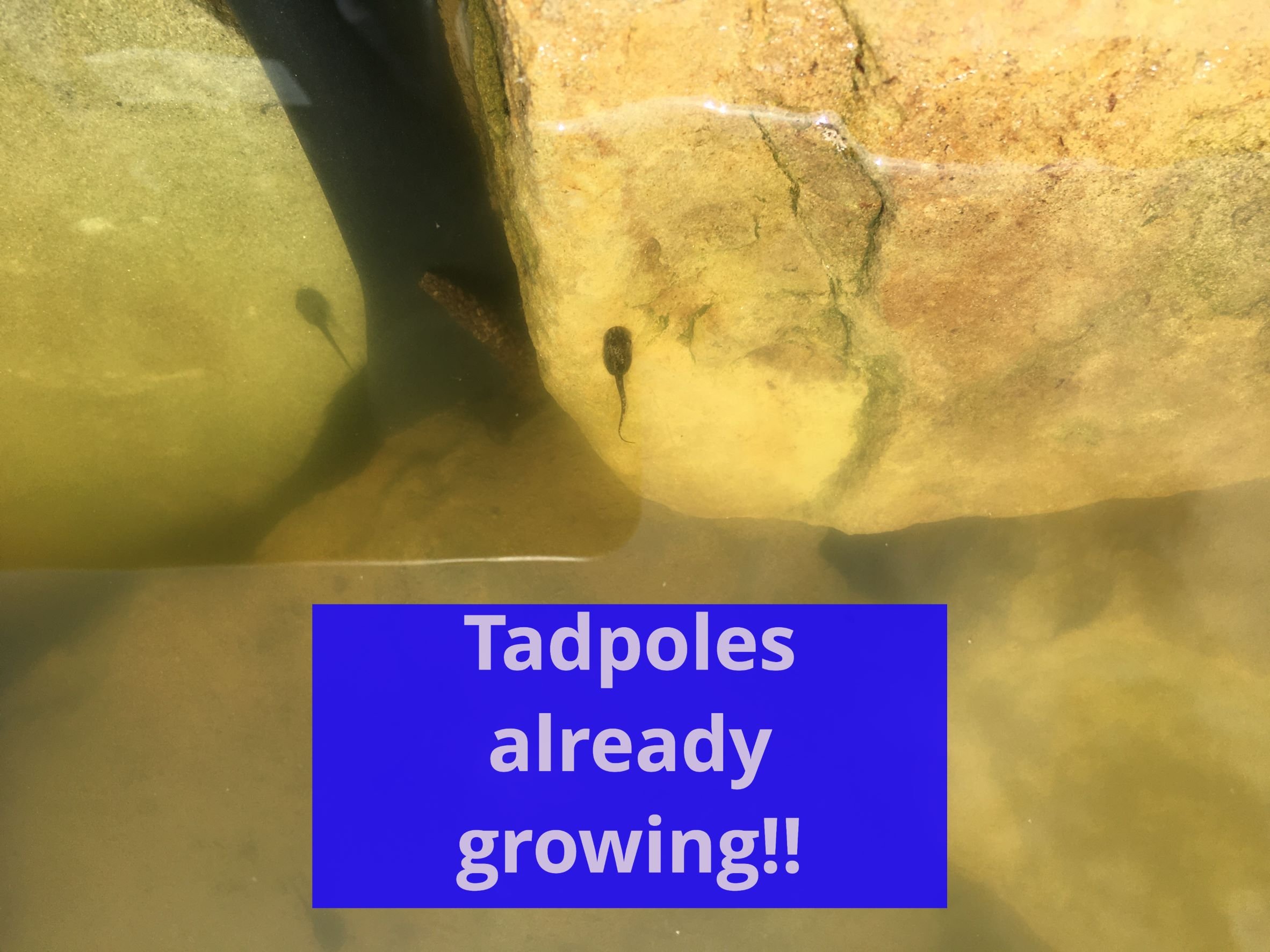
Remodelling the pond provided clean reliable water for the local wildlife. It is used by squirrels, birds, butterflies, and turtles as a source of water. In addition, students will add six native fish to the pond at the beginning of next school year. Finally, 12 pollinator plants were installed around the pond to improve biodiversity.
The students’ educational experience was enhanced in multiple ways by participating in the construction and maintenance of the pond. For example, they learned about rock identification, water flow, soil studies, aquatic plant life. On any lovely weather day, but especially during the times of COVID, this project provided joy and stress relief for the high schoolers. This project also taught them the simple pleasure and satisfaction of doing physical labor outside that resulted in a beautiful and completed project. Overall, this practical stewardship experience increased their life skills and improved their relationship with nature.
“It is hard to put into words the enthusiasm and happiness that most of my students displayed when they knew we would be working outside on this project. It was an uplifting experience for me to watch them become absorbed in the project either through creativity and/or physical activity. It was learning at its best.”
- Rebecca Schnur, teacher.
The Alcoa W5 project at Boonville High School support the following SDGs:

Building a Safe Home for Pollinators
Castle Elementary School, USA
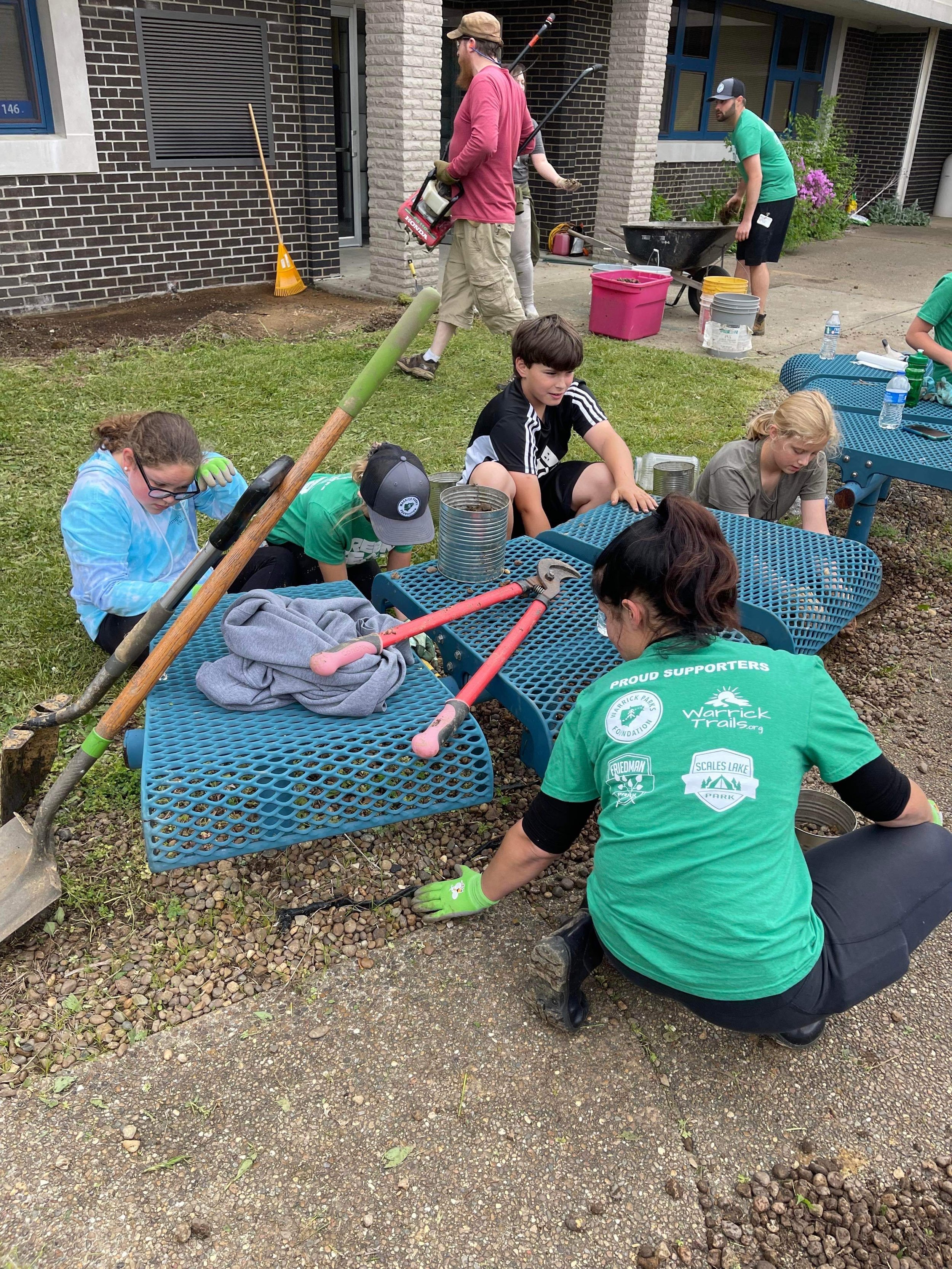
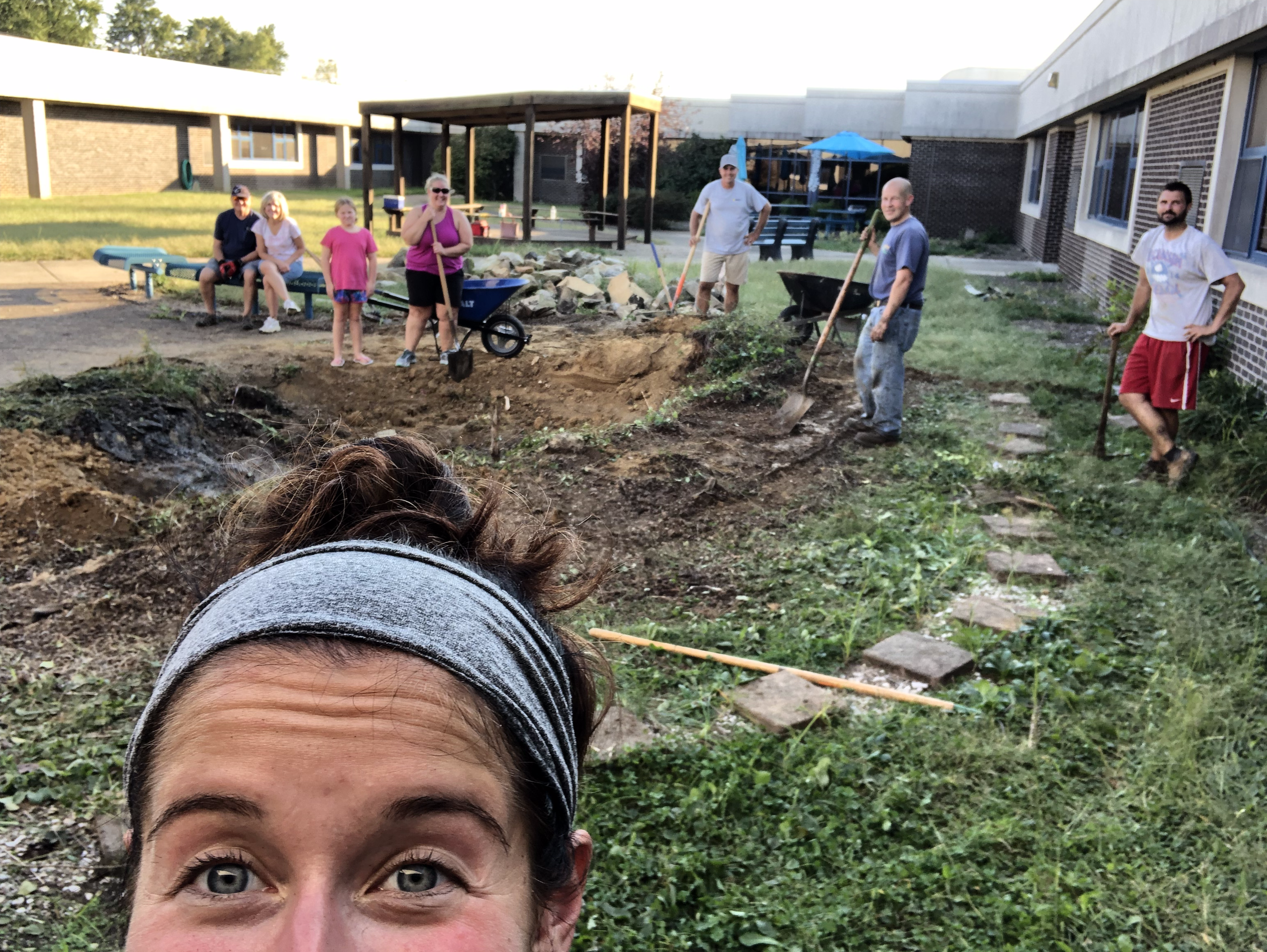
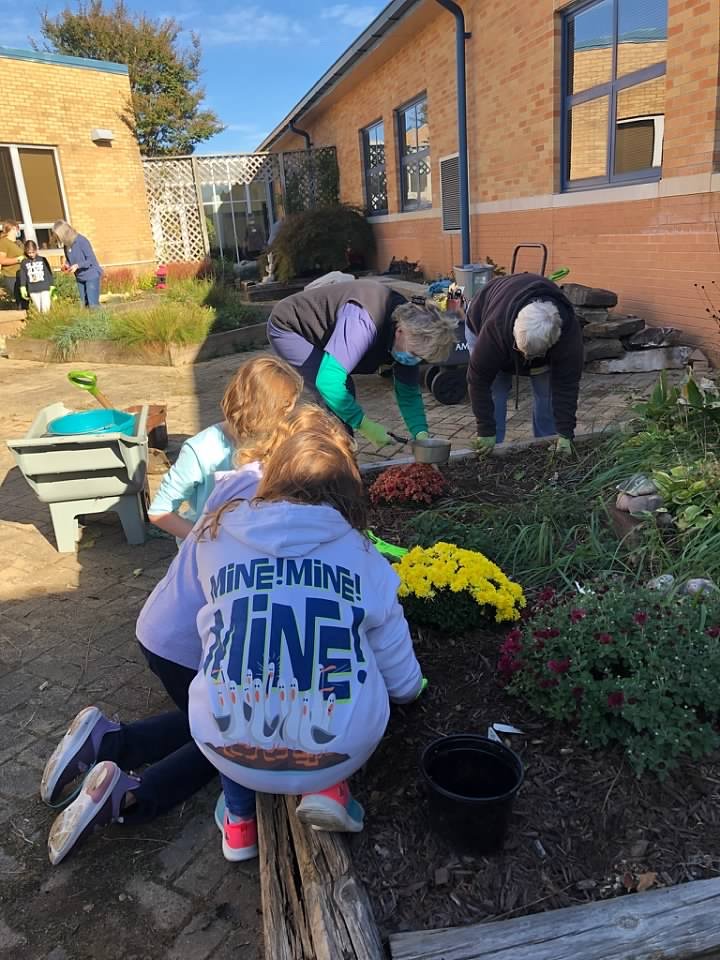
An awesome initiative took place at Castle Elementary School in the U.S. where they decided to create a pollinator-friendly garden. With the help of the Indiana Native Plant Society, students from the Green Team and their teachers planted native species for pollinators in the school courtyard.
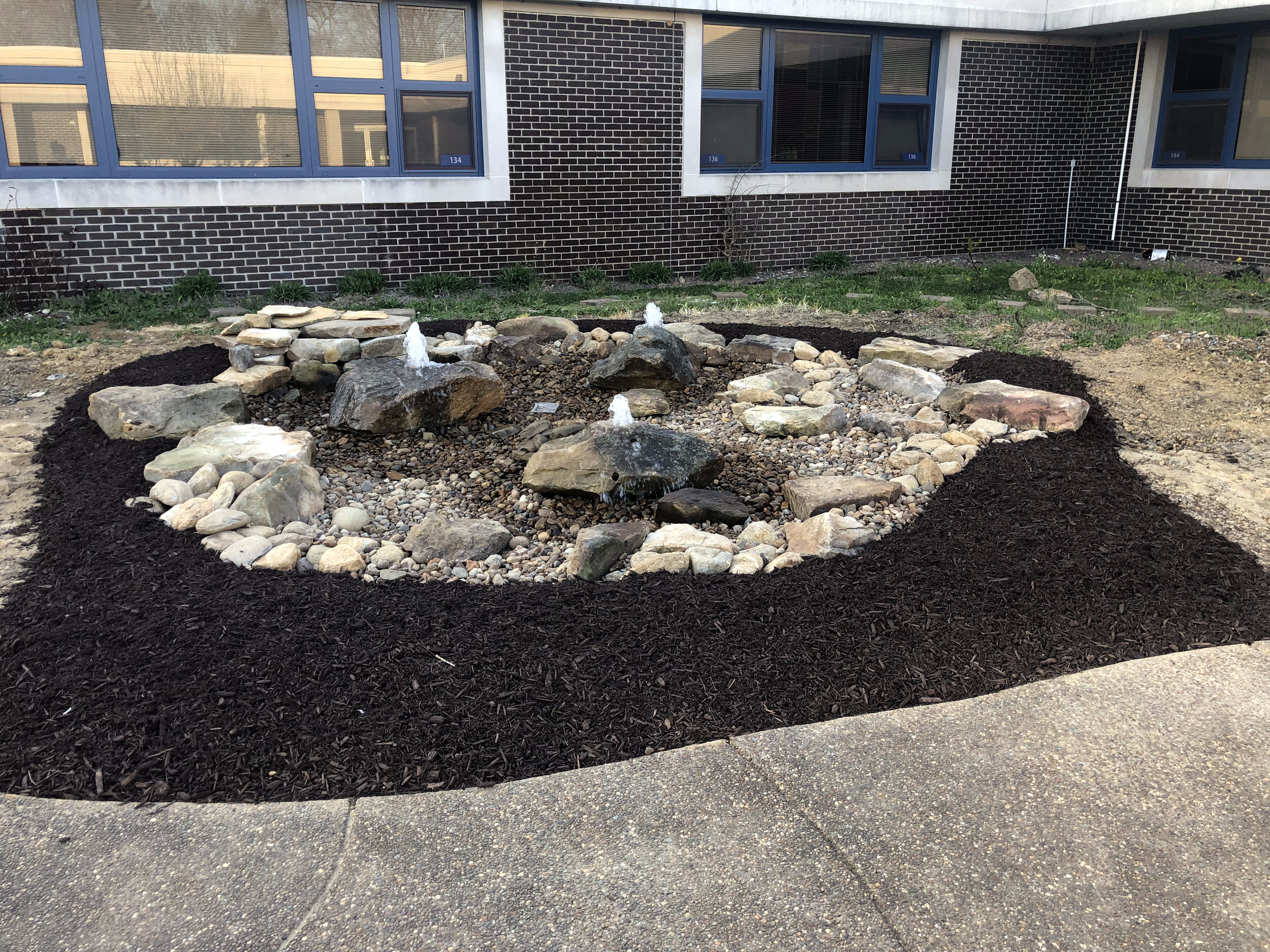
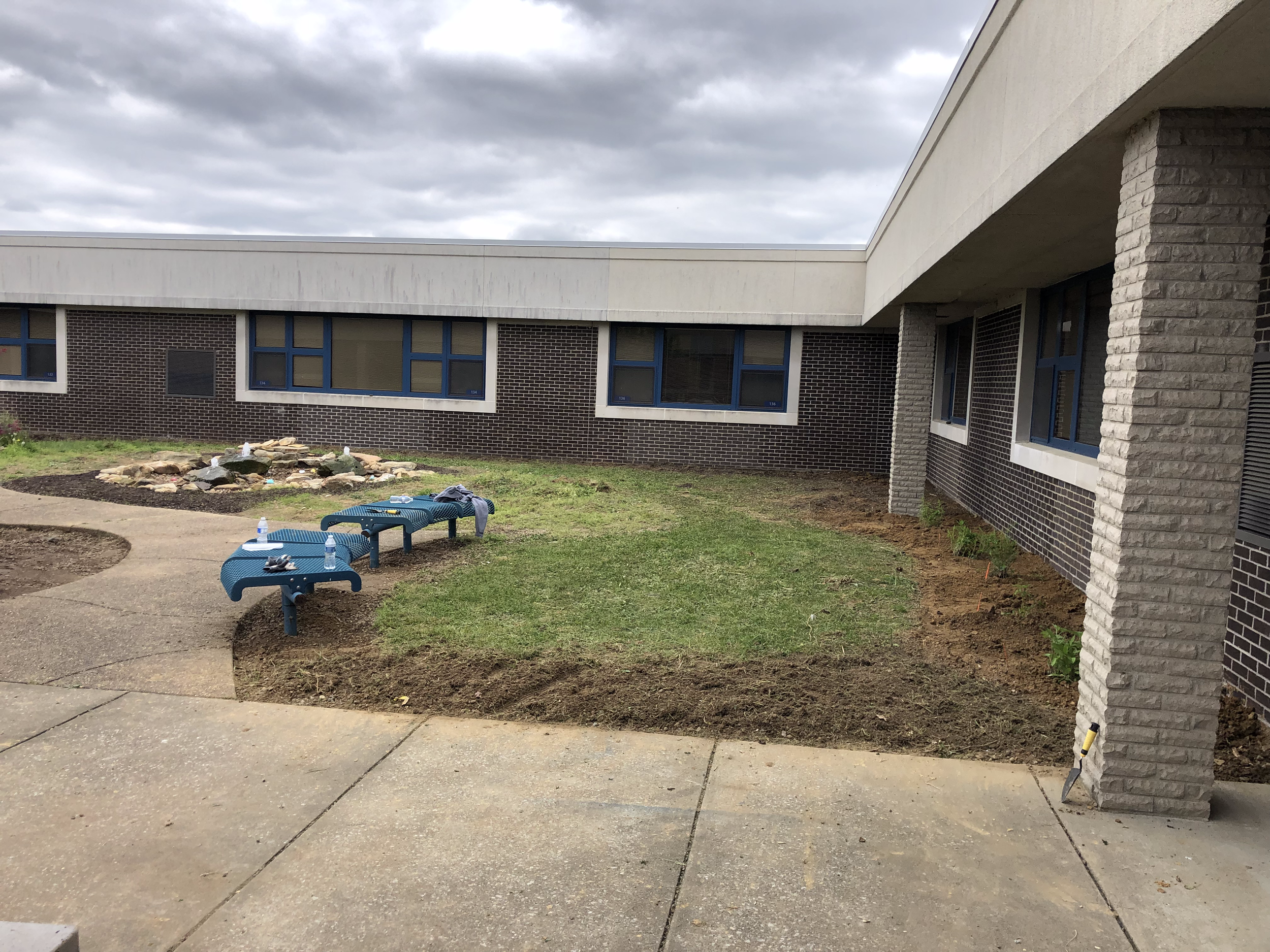
22 students between the age of 8-10 were part of the Green Team during the project. The idea was to remove the broken pond from the school courtyard and use the space for creating a more biodiverse natural area. They removed the non-native and invasive plant species from the ground and replaced them with native species only. A new fountain was installed in the pond’s place to create a clean water source for pollinators.
The teachers that coordinated the project were already very interested in pollinators. They had brought caterpillars into the classroom to let the students watch their lifecycle. Creating a pollinator garden was the next step to allow them to study these insects directly in the school. They wanted to educate students on the lifecycle of different plants and insects. By building an area with native plants, they wanted to them to understand the importance of a biodiverse, local environment and how to take care of it.
“The teachers and students did an awesome job! You can tell an immediate difference when you walk up to the school. Thank you so much for putting in a tremendous amount of time with The Green Team. The courtyard experiences for our students are truly going to change in the coming years.”
- Adam Schmitt, Principal at Castle Elementary School
The main challenge of the initiative was the amount of work and the limited human resources, considering the large area to transform. Thankfully, the students’ families helped with the planting, local businesses donated items (tools, snacks, plants), and the Indiana Native Plant Society provided dozens of native plants. Thanks to the Alcoa W5 grant, the school was able to buy the necessary tools and equipment as well as pollinators plants.
Students and teachers gained a lot from this experience. They learnt how to support plants and pollinators in the garden and how to build a natural area for these species to live. They went from only a handful of milkweed plants to about 15 different types of native plants in their courtyard and they hope to add even more in the coming months.
The Alcoa W5 project activities at Castle North Middle School support the following SDGs:
Learning about Biodiversity by Adopting a Beach
Farsund Secondary School, Norway
Farsund Ungdomsskole, a secondary school in Norway, is a long-term participant in the Alcoa W5 project with great success! Under the banner of “The Ocean Monster”, the aim of the school has been to increase the awareness of issues of plastic waste, especially in the ocean, and to contribute to a clean and biodiverse coastal zone. For several years, students and teachers have used the whole municipality as a classroom and engaged with multiple stakeholders!
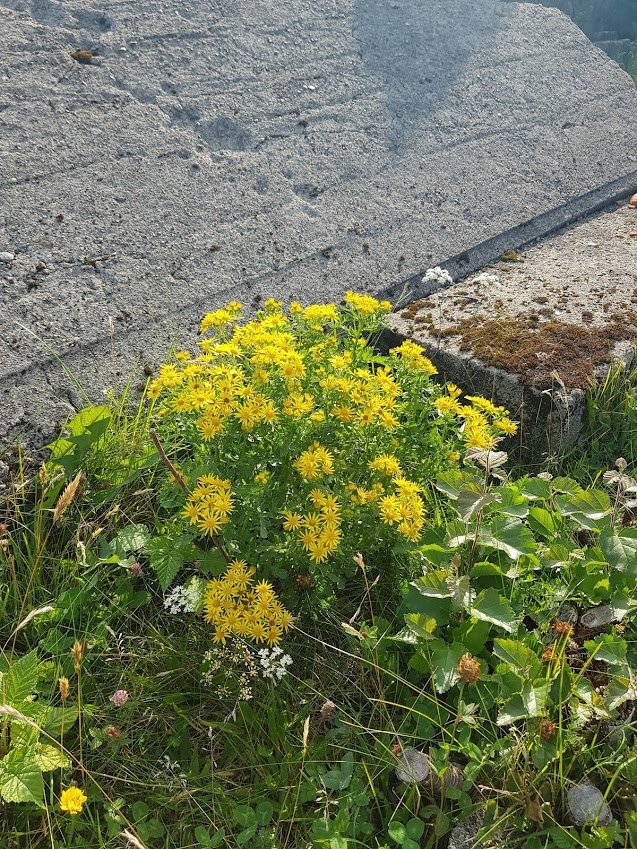
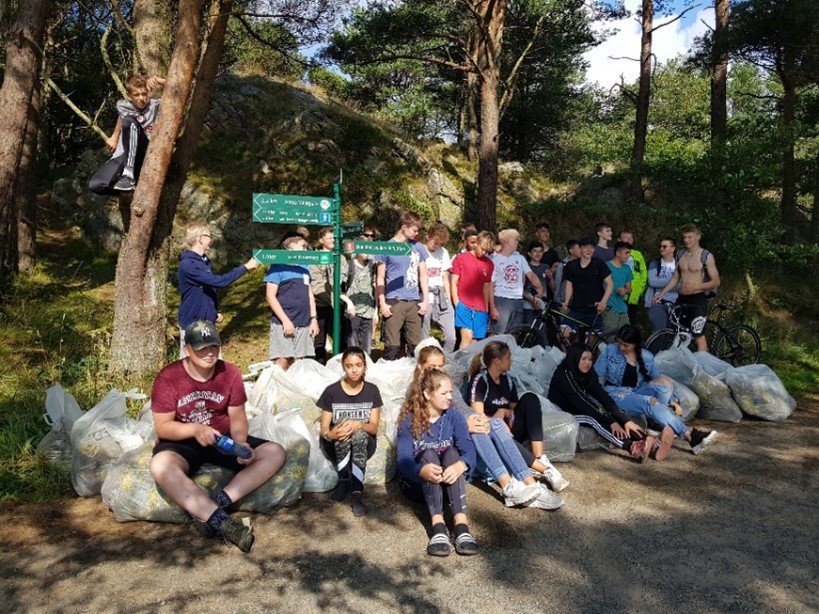
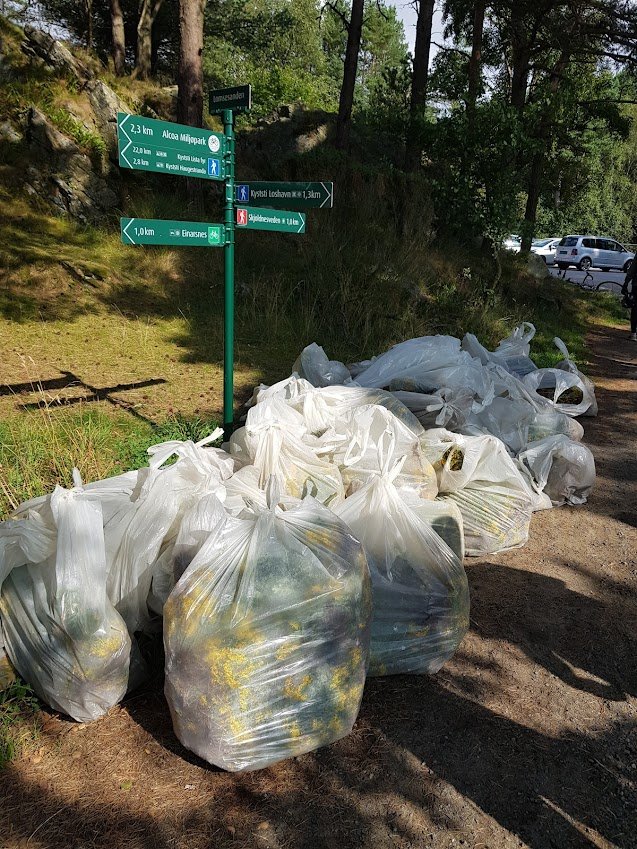
One of the school’s many inspiring initiatives is their adoption of a nearby beach. Back in August 2020, the 10th grade pupils lined up at the beach to help the municipality and the county governor remove the invasive species ragwort from the vulnerable habitats on Einarsnes. The day started with an informational session from Nature Manager Stig Alfred Eikeland about alien species that people in the municipality work on removing. Bjørn Vikøyr from the County Governors Department for Climate and the Environment talked about how unique the area Einarsnes is, and why the plants had to be removed.

Einarsnes is part of the protected areas at the Lista beaches. The area has experienced a sudden resurgence of ragwort. This particular plant is toxic to cattle and has the potential to spread quickly. The area is commonly used for hiking and tourism, and seeds could be spread very easily. This will be especially harmful here, not only because of the protected area with many endemic species, but also because of the surrounding agricultural areas.
Cattle farmer Jan Petter Gjertsen was also part of the efforts and was able to tell about the consequences that this plant has for his animals.
“Of course, it is sad to find animals that become seriously ill or at worst die due to the fact that they have eaten the plant, but this also has a very unfortunate economic consequence if the plant establishes itself. The plant does not bloom until autumn. Therefore, one can include the plant in the ensilage. Grass is collected first time in May or June, and farmers cannot detect the toxic plants until the flowers appear early in the autumn, around August or September. If farmers suspect that ragwort is included in the ensilage, large values must be condemned. If I have to buy ensilage from others, this means that a monthly salary or two quickly disappears.”
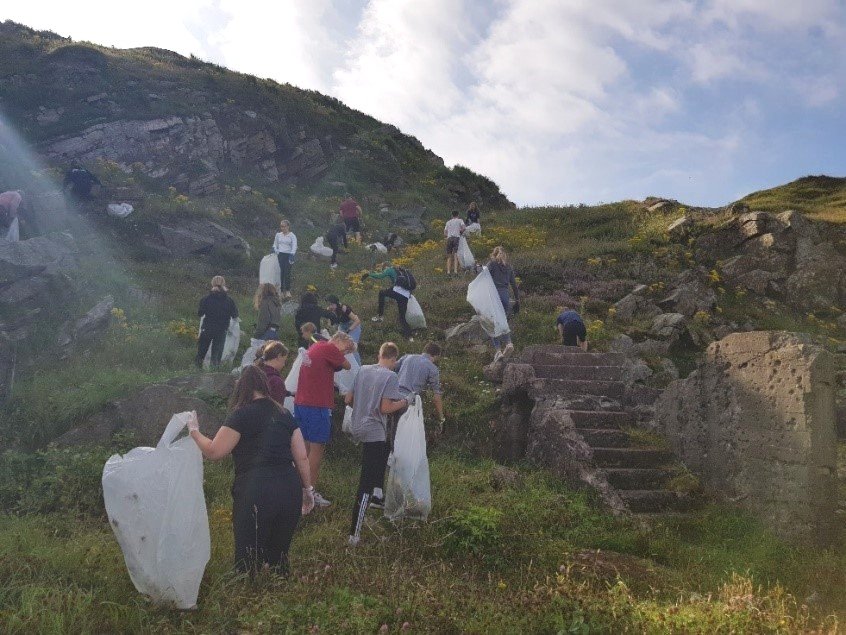
The pupils and teachers were blessed with wonderful weather and a lovely view. They worked on removing the plant for many hours but enjoyed each other’s company and a good lunch outdoors. “It feels important”, many of the pupils stated. Another pupil said that this was much more interesting than regular school, because he was actually saving animals.

The farmer and representation from the municipality and county governor were impressed by the energy that the students showed in the work of removing the plant.
"It was a great experience to see how quickly Einarsnes was emptied of the mob plant when the young people started working!"
The hope is that students bring home the lessons they have learnt and remove the weed from around their houses as well.
Farsund Ungdomsskole has been awarded a Green Flag for their work on preserving species diversity. They continue keeping the beach clean from marine waste, removing weed-plants such as ragwort and broom, and planting and taking care of the vulnerable plant seaholly at this same area.
The W5 project has created many opportunities for learning and skills development. Students have learnt about the importance of ecosystems, the issue of litter and waste, how to take positive action, communication, collaboration and negotiation (e.g. with politicians, shops, volunteers, scientists, and divers) to solve the problem of plastic waste, and taking ownership of the solutions.
The school is also very active in communicating about their environmental efforts and has been featured in the news of the Norwegian State TV-channel, a local news report, and the local newspaper, to name a few.
The Alcoa W5 project activities at Farsund Ungdomsskole support the following SDGs:

Eat Locally, Think Globally
Liknes Primary School, Norway
At Liknes Primary School in Norway, over 200 students ages 6-13 and 20 teachers worked together to transform their relationship with sustainable food consumption. In their Alcoa W5 project, Kitchen Garden, the students collaborated on growing, foraging, cooking, and enjoying their own local food!
The idea for the Kitchen Garden project arose when students chose to focus on the themes of sustainable food production/consumption and biodiversity as they worked towards their first Green Flag. The school already had a kitchen garden before the project, but it was challenging to involve the whole school and give everyone ownership. The Eco-School framework and the W5 project gave them the tools needed to transform the garden while successfully involving the whole school in the process. Even now, after a year of implementation, the excitement of the students continues!
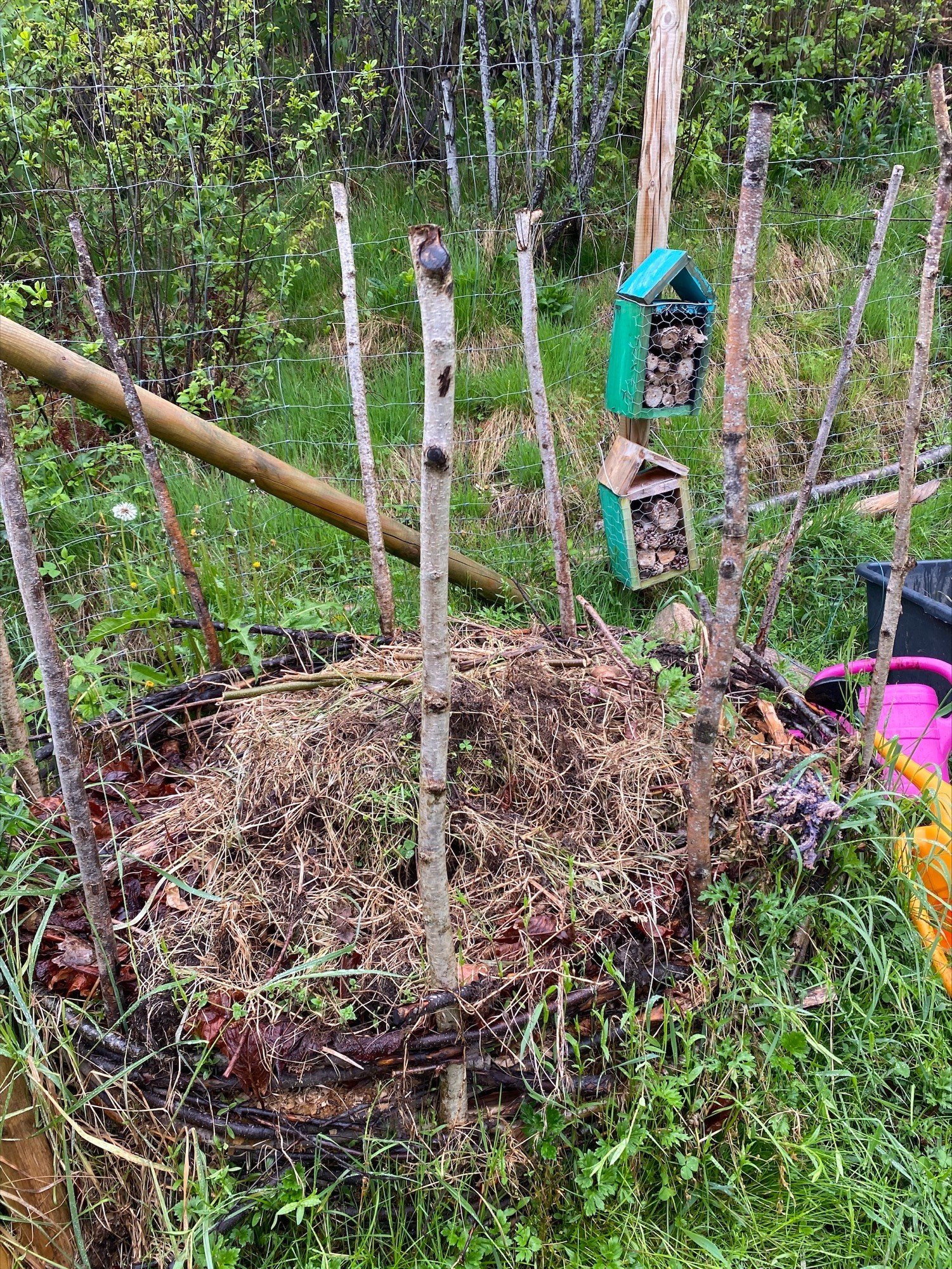
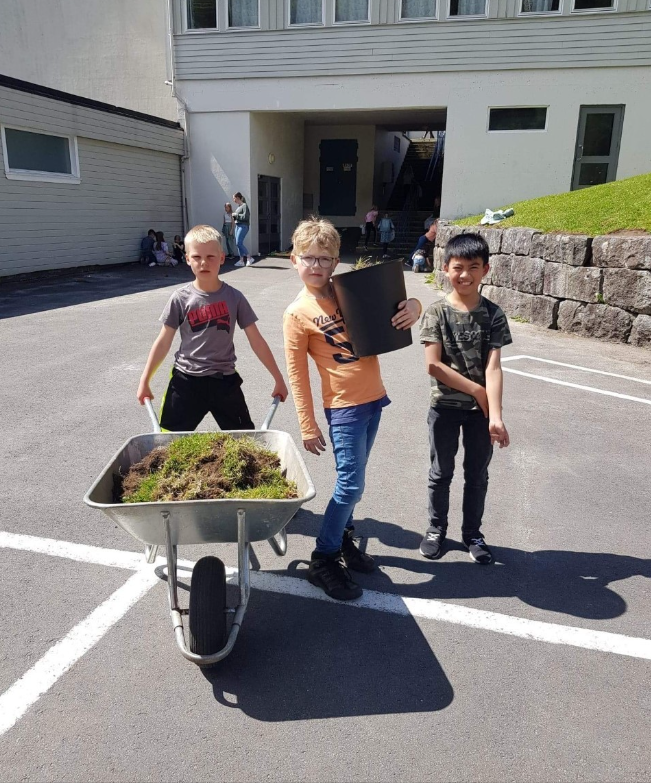
Preparation for the garden was done through school-wide collaboration between students and staff. Approximately 250 edible plants were planted. These included several types of kale, brussels sprouts, potatoes, carrots, leek, onions, turnip, lettuce, pumpkin, peas, sunflowers, marigolds, and tagetes.
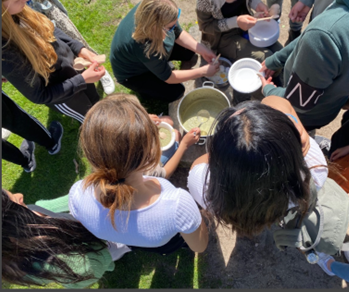
In addition to planting and harvesting from the garden, there were several supporting activities to their project. The seventh-grade students went to the local seashore to harvest another delicious local ingredient, seaweed, that they used for cooking. Students also foraged wild nettles which they made into a delicious soup that everyone had the chance to enjoy - even the school principal! In connection with the topic of sustainable consumption, fourth graders visited a renovation site to witness an example of sustainable waste management.
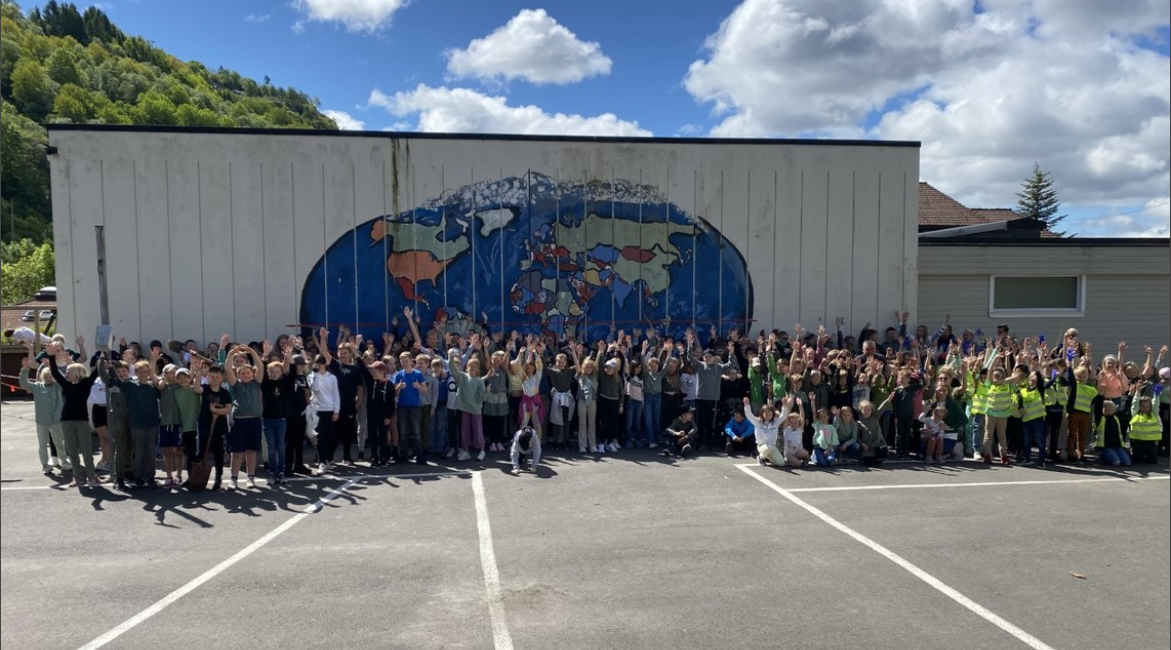
On June 3rd, at the end of the term, the school held an Activity Day to celebrate the progress achieved so far towards the Green Flag award and participation in Alcoa W5. The celebration included a variety of activities for different age-groups: planting pollinator-friendly flowers in the school garden, spending time in local natural surroundings, a litter clean-up, a student curated art exhibit from recycled materials, and a climate friendly meal of nettle soup.
“The Activity Day was a fun day that inspired the students and teachers to do something positive for our school and the Environment. We are very happy that we are now making progress!” -Anne Hobbesland Eftestøl, teacher
As this project was one of the first Eco-Schools projects done at Liknes, it was simultaneously an opportunity for students and staff to practice using the Seven Steps in planning, implementing, and evaluating their progress towards their sustainable development goals. Through the Kitchen Garden project, students gained conceptual, emotional, and behavioural knowledge about the planting process, climate neutral meals, and the value of being connected to their local environment.
The Alcoa W5 project activities at Liknes Primary School support the following SDGs:

One Small Thing - A Human Behaviour Experiment
Woodland Hills Senior High School, USA
As part of the Alcoa W5 project, students and teachers from Woodland Hills Senior High School in the US decided to identify areas of overconsumption and waste in their own lives and design a behavioural experiment to improve their habits!
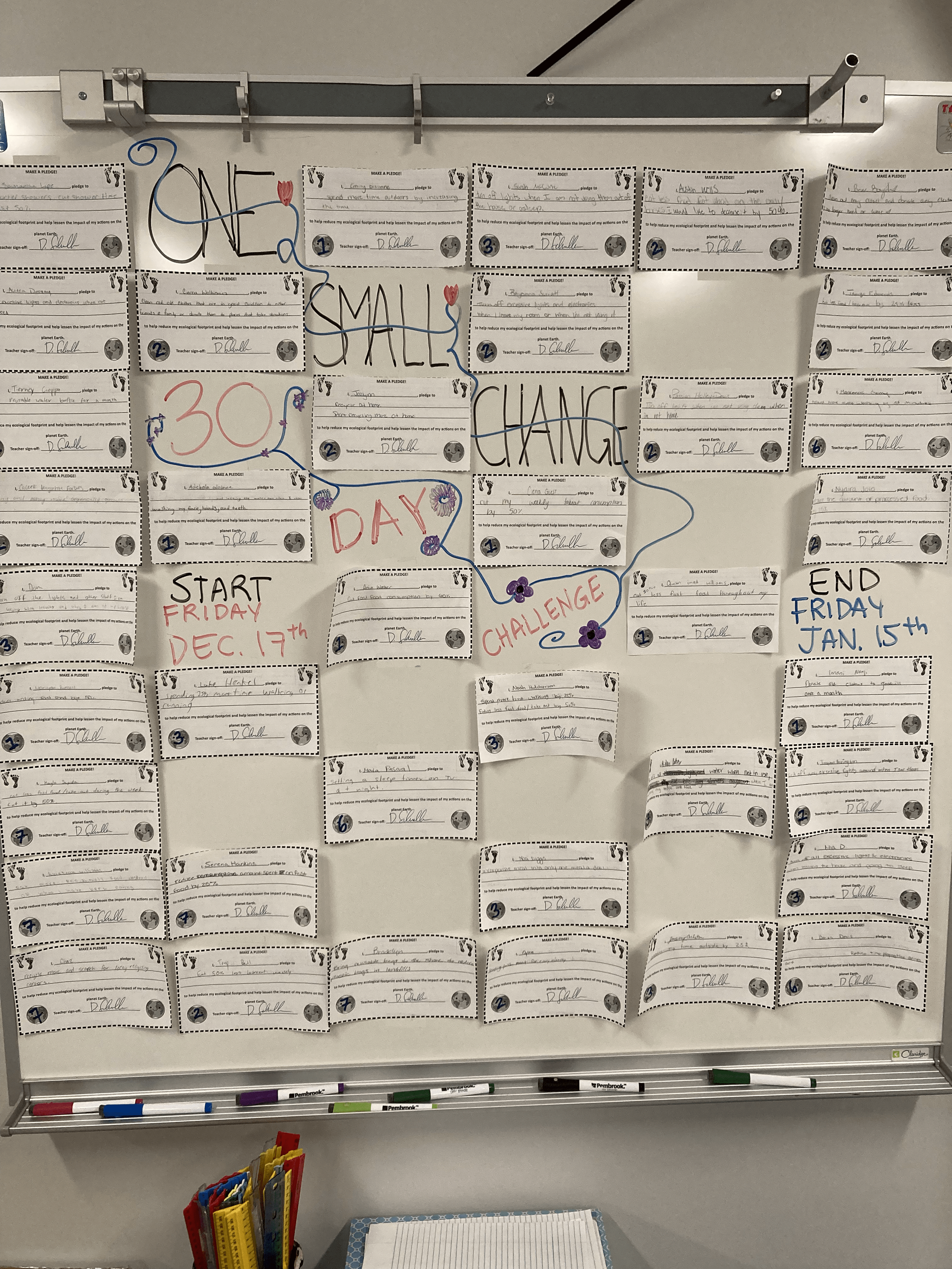
The One Small Thing initiative was inspired by a similar activity done by a fellow environmental educator. Students identified one small action in their daily lives that they could change to benefit the environment and monitored their achievements over a period of 30 days. They also did research on the impact their behaviour had on the environment before and after the change. The ultimate goal was to improve their own habits and to positively influence their peers and family with their behaviour change.
The One Small Thing initiative started in December 2021 and lasted until February of 2022. It involved a five-step process that students had to go through:
Completing an Ecological Footprint Survey to monitor individual students’ consumption habits and areas of overconsumption.
Focusing on their top three areas of overconsumption, they identified actions that could lessen the impact of their behaviours. From those actions, they had to create an Action Statement.
Collecting baseline data before completing their Action Statement. The baseline data was to provide a comparison of behaviour before the change took place.
Starting the Action Statement and carrying out the change for a duration of 30 days. During this step, students were asked to journal their actions, their struggles, and successes.
Creating a Final Report consisting of a summation and reflection of the entire process.
Through this process, students learned that changing their behaviour could be very difficult especially when the impact seems small or insignificant within the context of a larger, complex problem like climate change. However, they also realised that even the biggest problems and challenges can be broken down into smaller, manageable, and actionable steps – and that their lifestyle choices and behaviours have a greater impact on the environment than they realized!
As highlighted by the organising teacher:
“Through this project, my students learnt they can develop a real-life experiment involving themselves and come to real conclusions”!
The Alcoa W5 project of Woodland Hills Senior High School supports the following SDGs:
Student Climate Experts Taking Action
Jefferson Elementary School, USA
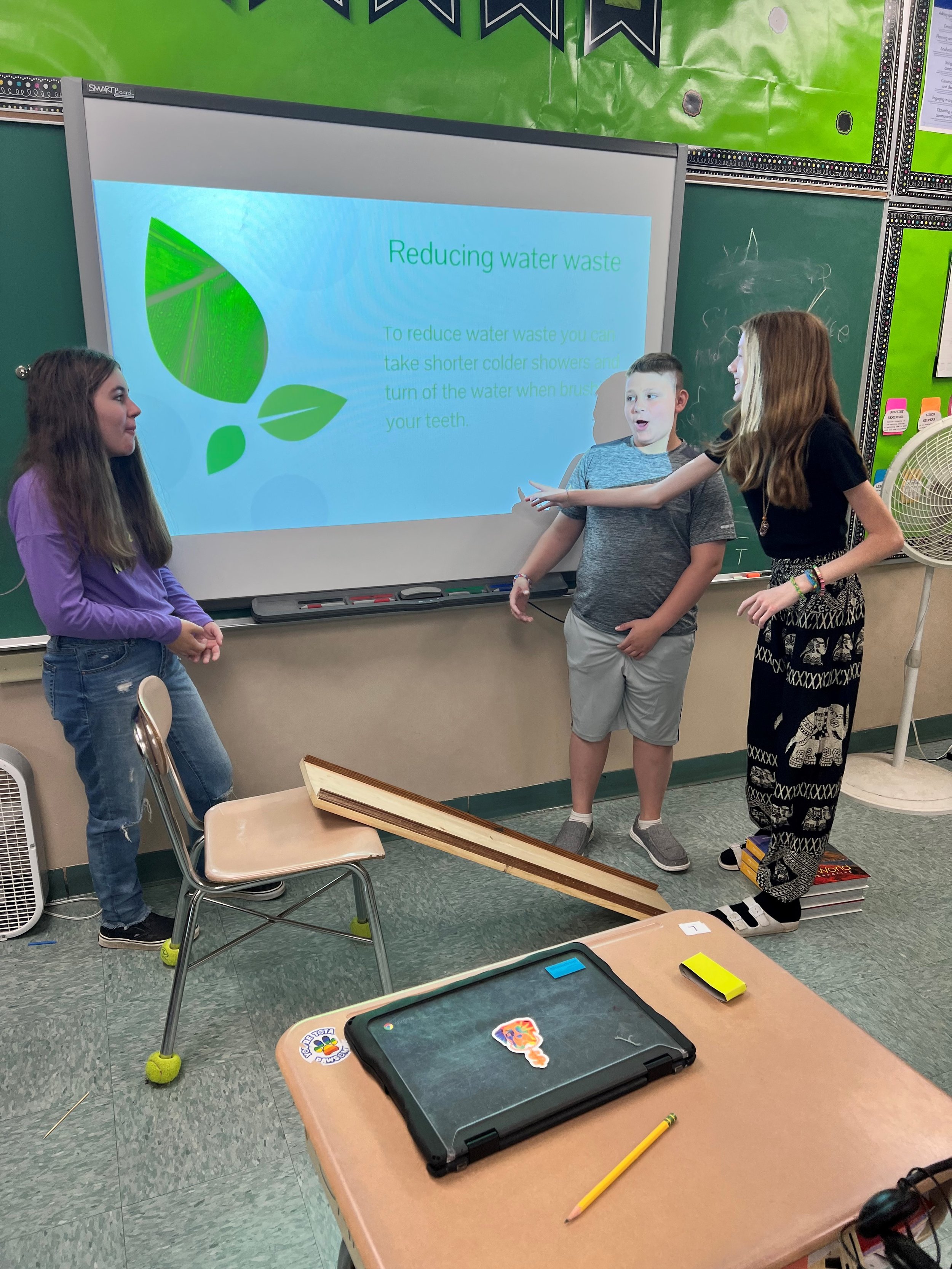
6th grade science students at Jefferson Elementary School in Massena, NY wanted to transform their climate change knowledge into action! They created the Climate Change in Action project to reduce their own carbon footprints while educating younger students about how to reduce theirs!
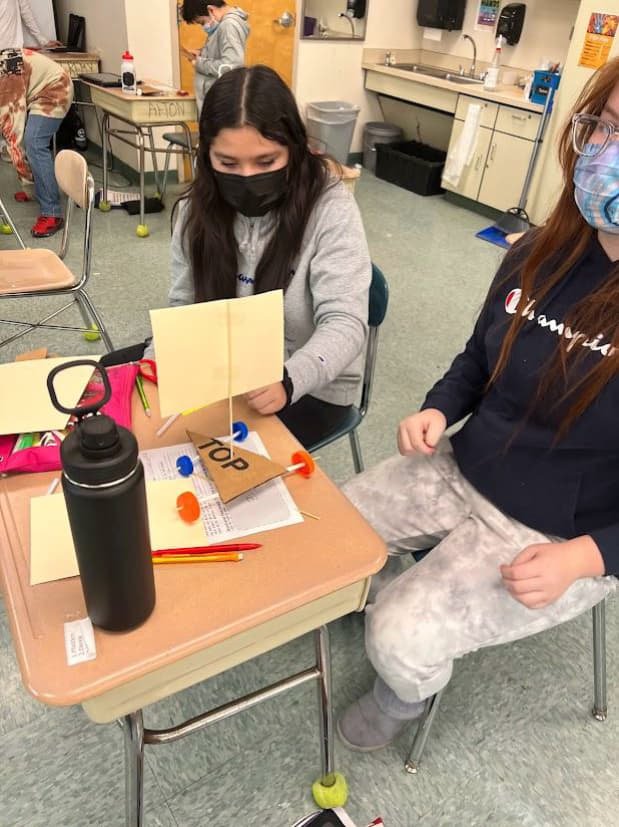
The sixth graders first decided to learn more about renewable energy. They investigated hydropower (how to use falling or fast-running water to produce electricity) which is the principle renewable energy source in their community. They also looked to other countries, for example the geothermal energy used in Iceland. Through a hands-on activity, they even designed and constructed small, wind-powered cars!
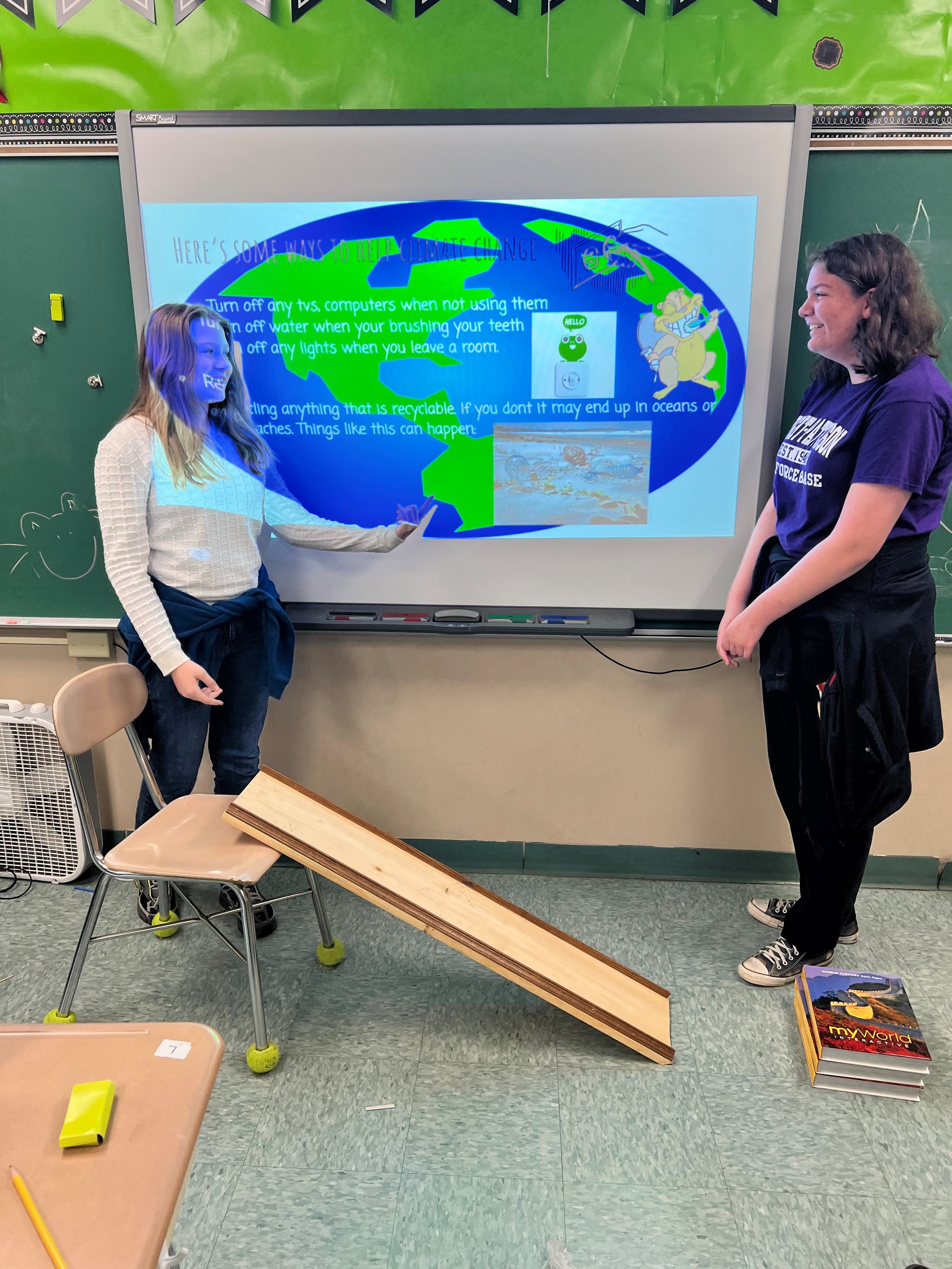
Building on their knowledge, students explored simple strategies for reducing their carbon footprint such as bringing refillable water bottles instead of single-use plastic ones, turning the water off when brushing their teeth, turning off lights when leaving a room, and unplugging appliances and chargers. They shared these with the wider school community by making posters to raise awareness and hanging them in the corridors.
“Climate change is something that we have caused, but also something we can help fix. We need to do better.” Brynn, 6th grade student
The local community also supported the students’ efforts by donating trees. Five of the trees were planted by students in front of the school and others were brought home to plant.
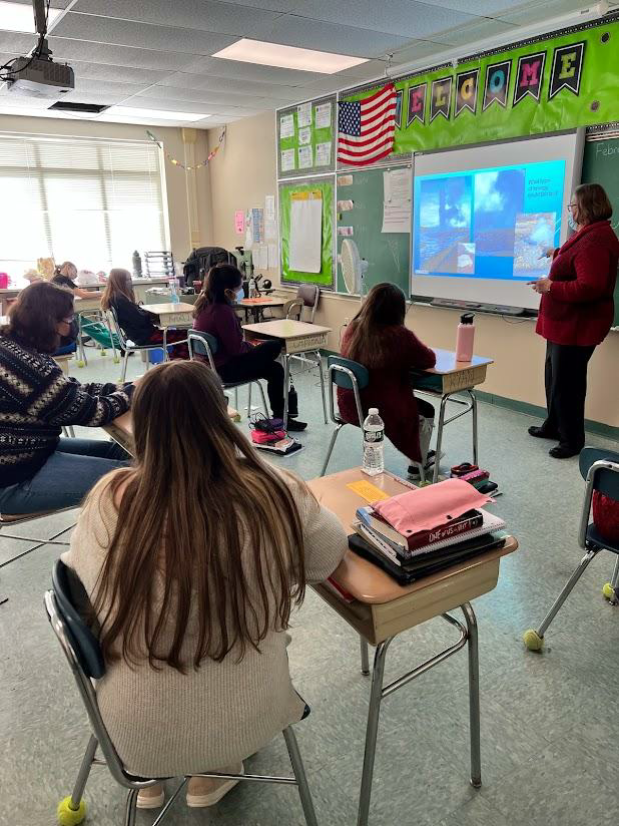
These active sixth graders went on to compile all their findings into presentations that were made to suit different age levels. They then made a sign-up sheet that was passed around the school so teachers could schedule the student climate experts to present to their classes. These actions gave students a positive feeling of agency that their actions against climate change matter!
The Alcoa W5 project activities at Jefferson Elementary School support the following SDGs:
Climate Action at School and Beyond!
Turtle Creek Elementary STEAM Academy, USA
When their school district passed a resolution to initiate climate action in schools, students and teachers at Turtle Creek Elementary STEAM Academy in Pennsylvania, U.S. jumped into action!
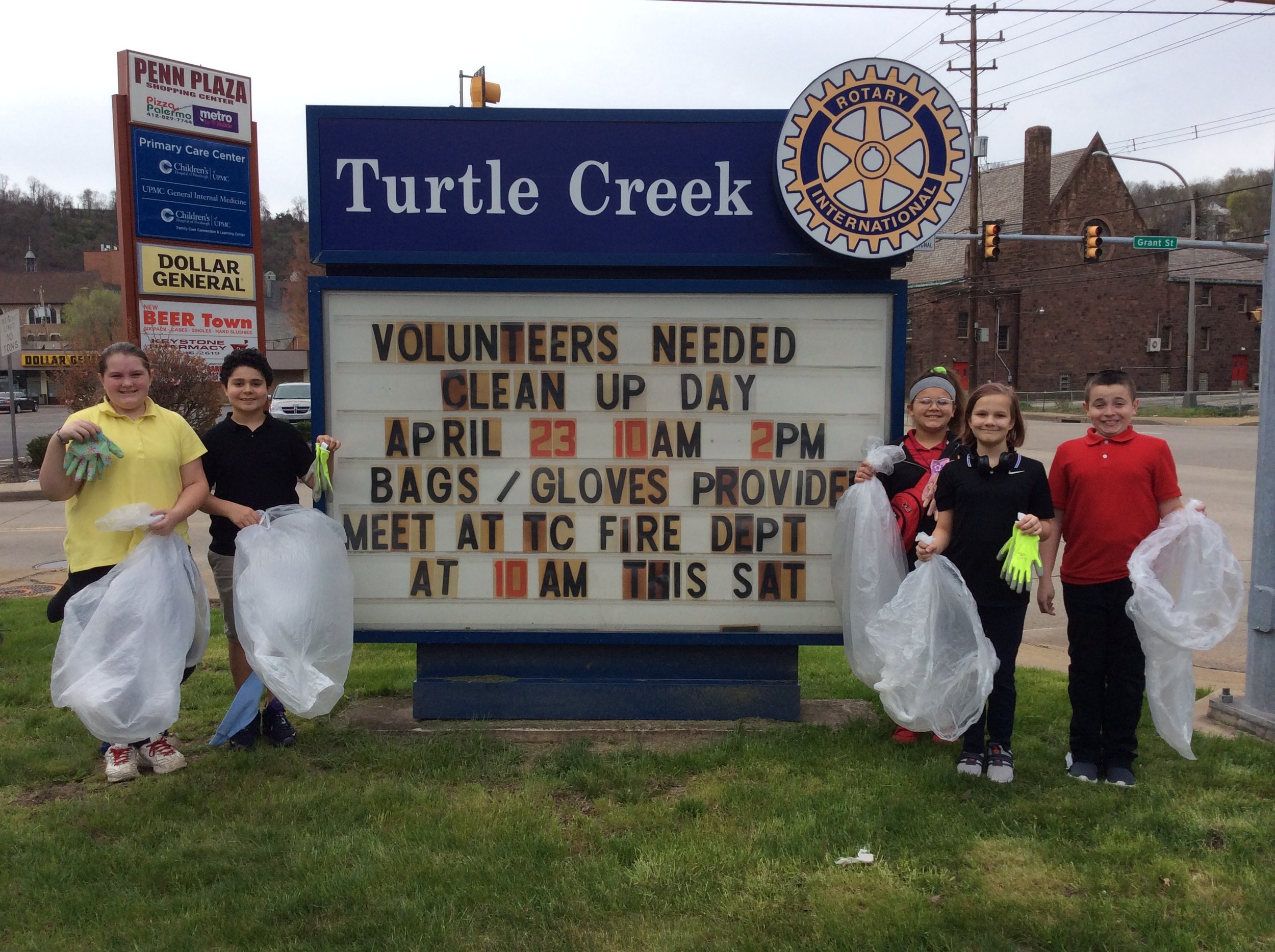
Students from 5th grade formed the Green Team and developed and planned climate action activities for the entire school! The goal of this Alcoa W5 project was to provide opportunities for the entire school to engage in climate action projects focused on green infrastructure, zero waste, and clean energy that would enhance not only the school, but the community as well. They also wanted to reduce the amount of waste (especially paper and plastic) created at the school and in the Turtle Creek Community, provide recycling opportunities, encourage reduction of carbon emissions, and install green infrastructure at the school.
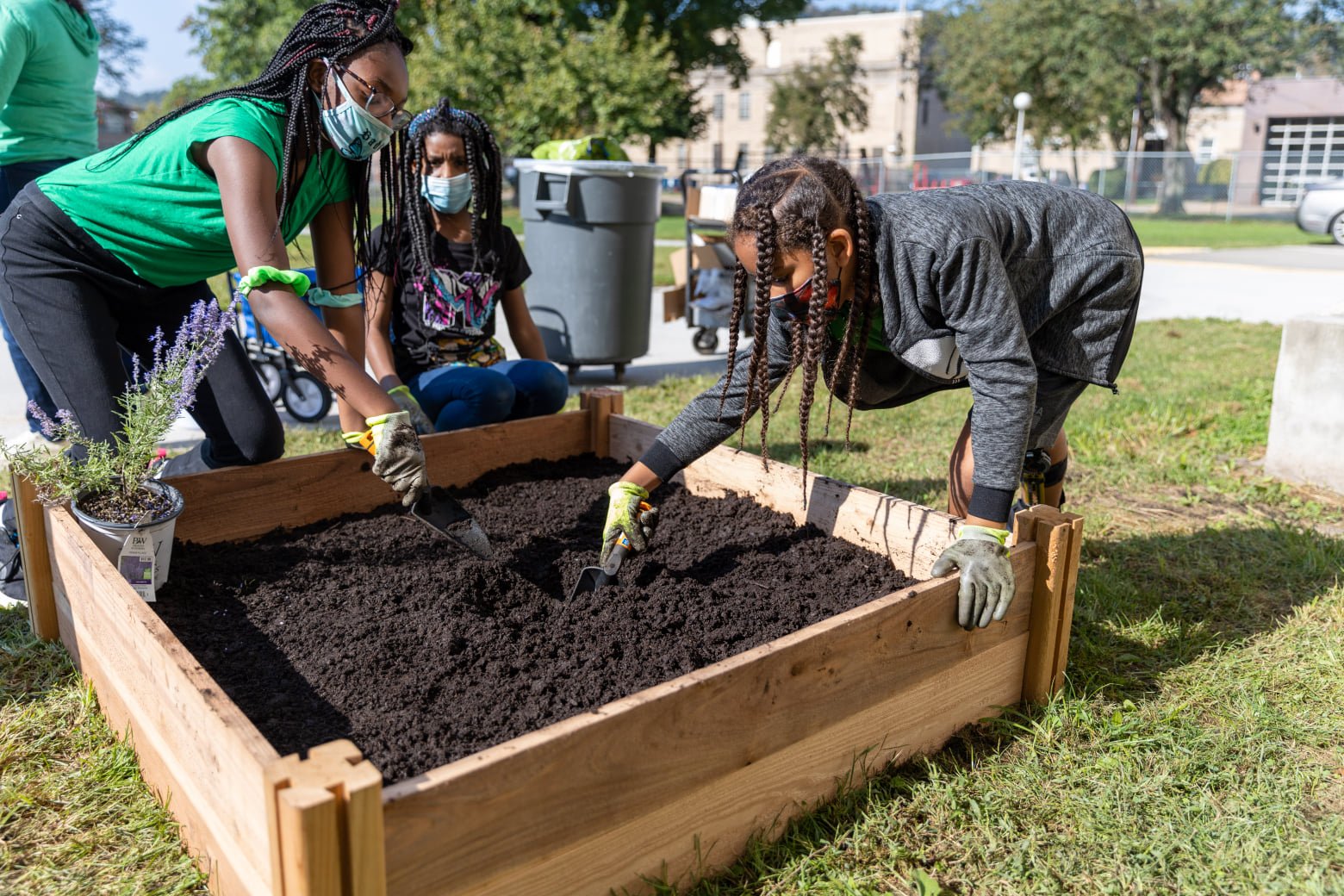
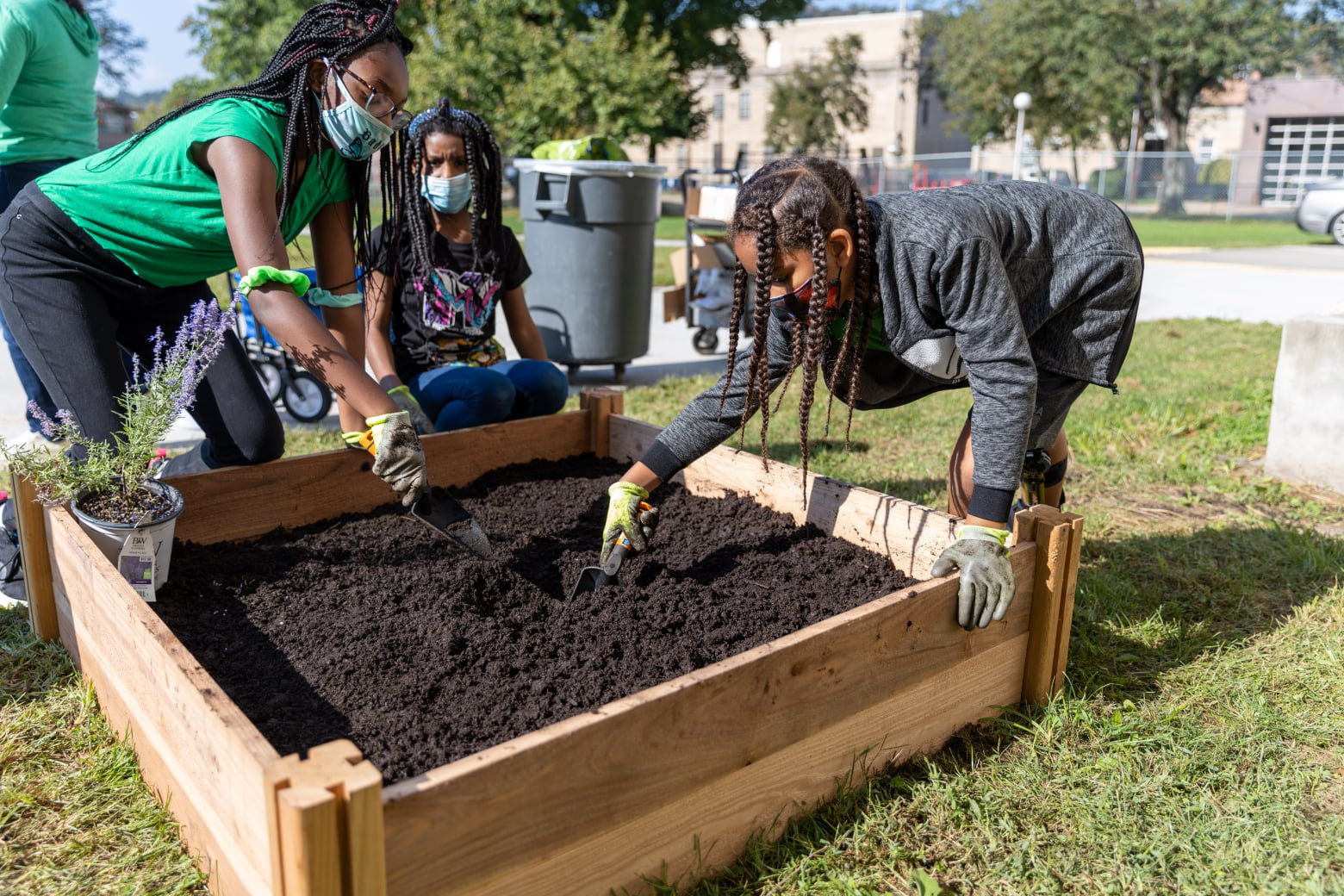
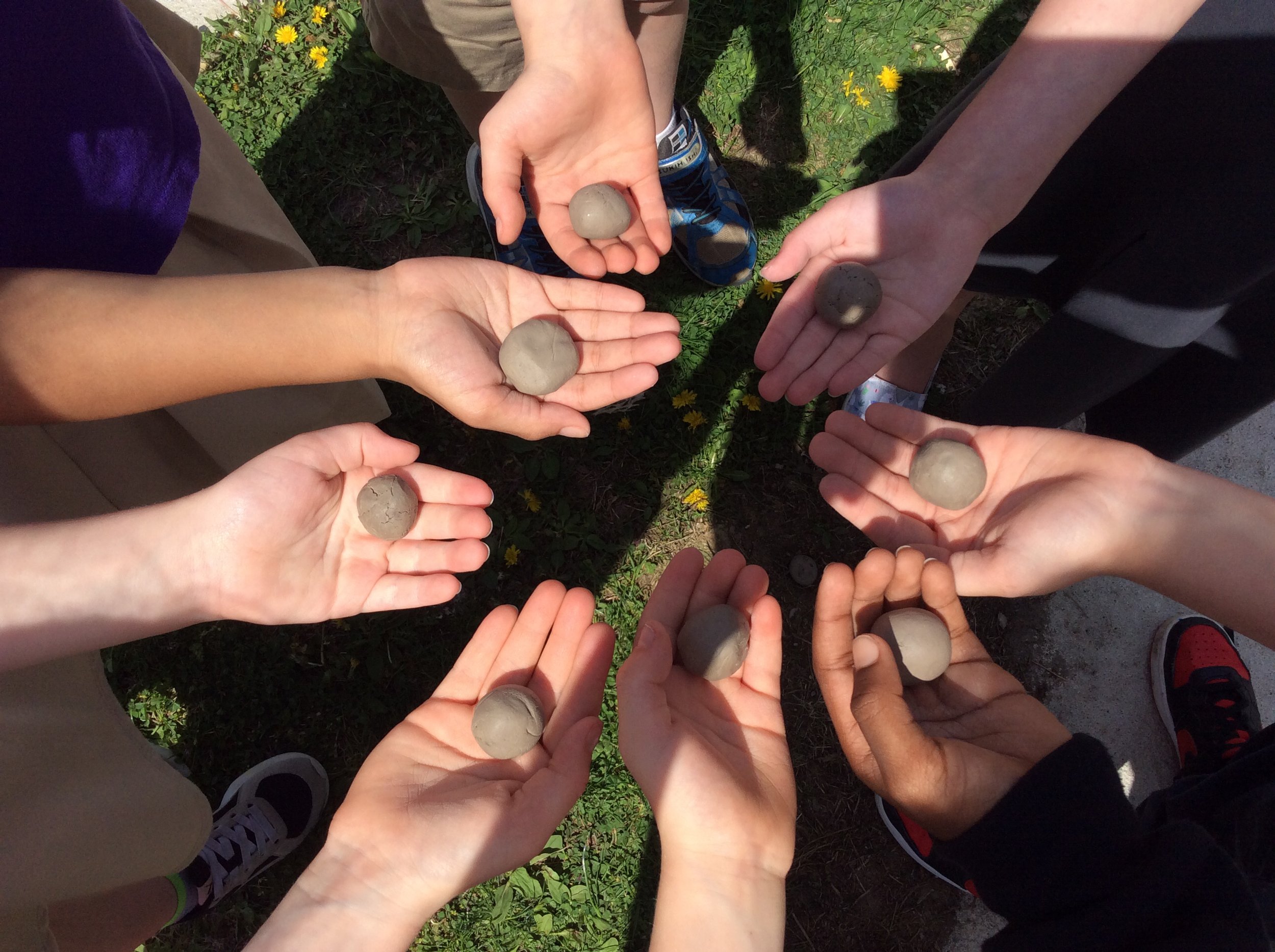
So that’s just what the Green Team did! They set up a recycling programme in all the classrooms, planned and implemented a community clean-up day in the borough of Turtle Creek, and even designed lessons and action projects for younger students to teach them about climate change issues including ocean plastic pollution, the importance of bees, alternative energy sources, recycling and zero waste practices, and water conservation. As part of the project, five new trees were planted on the Turtle Creek Campus, five garden beds were created as part of the learning garden, and two rain barrels were installed. 527 students made seed balls with pollinator friendly seeds and beeswax wraps to reduce waste, while 35 classrooms participated in the school-wide recycling programme.
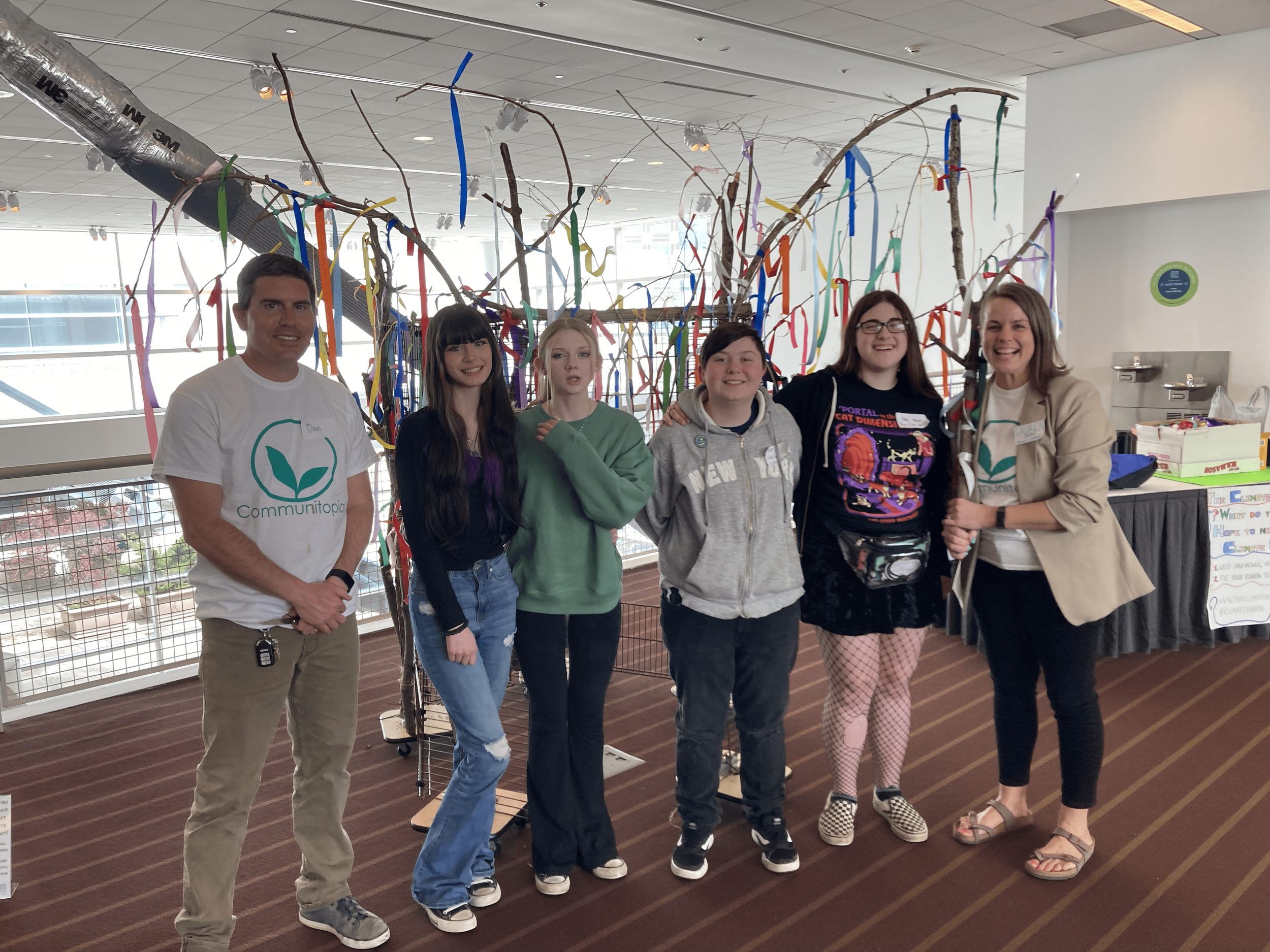
The actions weren’t just limited to the students and teachers at the Turtle Creek Elementary STEAM Academy however! Parents and school board members helped plant trees and install the garden beds, while community members, including the Turtle Creek mayor and council members joined in for the Turtle Creek clean-up day. Turtle Creek Elementary STEAM Academy also worked with partners from several local climate action organisations including Communitopia, Tree Pittsburgh, Chatham University, Phipps Conservatory and Botanical Garden, Rivers of Steel (Environmental Science on the Three Rivers), Planted Bee, National Geographic, Ohio River Valley Water Sanitation Commission, Pennsylvania Resources Council. These collaborations helped create an even more impactful and enriching experience for all those involved. As Katie Modic, the Executive Director of Communitopia expressed,
“Turtle Creek students bring authentic, genuine energy and talent to the movement for climate change solutions. Their efforts set precedent, demonstrate potential, inspire, and literally impact positive change. It's an honor to bear witness to youth developing mindsets and skill sets that change systems for the better. My respect for you and your students is real and everlasting!”
Through their Alcoa W5 project, students learned about multiple strategies to reduce their contributions to climate change at home and at school. By the end of the year, a survey showed that 100% of students responded that they take actions to help reduce climate change.
The Alcoa W5 project of Turtle Creek Elementary STEAM Academy support the following SDGs:
Appreciating Tiny Seeds
Espira Husebyparken Preschool, Norway
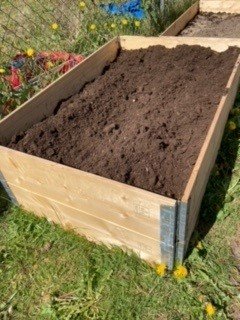
As part of their Alcoa W5 project, teachers at Espira Husebyparken Preschool in Norway wanted to increase the children’s knowledge of ecosystems at both foundational and practical level, including their understanding of where food comes from and how to plant different vegetables, berries, and flowers.
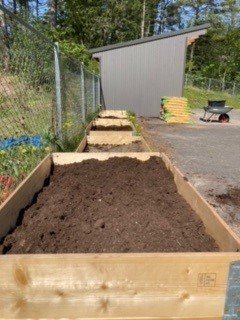
During the winter months, the preschool planned their kitchen garden and bought everything they needed for the raised beds and planting. They chose to plant species that can be harvested at different times, including potatoes, carrots, tomatoes, peas, wild strawberries, and sunflowers. The community got involved too! Their local garden center offered advice on how to plant potatoes in raised beds and parents received regular updates on the project.
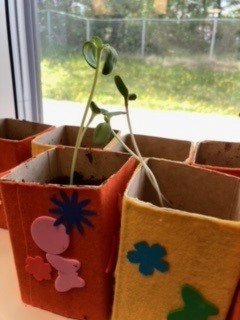
By spring, the children were ready to go outside and start planting! The teachers observed that the children started to understand the connection between the seed, the planting process, and the food. The children seemed fascinated experiencing how a seed grows, becomes a plant, and can produce food!
“Through this project, we would like to give the children a greater understanding of how things are connected in nature, to help them understand where food comes from, and that a seed can become something edible. We now observe that the children identify seeds in the fruit they eat and are more aware of these processes. We also want to teach the children about sustainable consumption and in the long run, we plan to involve the children in activities where they can experience the value of re-using materials.” – Principal, Lene Margrethe Skeibrok
The preschool has come a long way from when they first introduced the Eco-Schools’ Seven Steps. Since last autumn, they have been working towards a Green Flag and have come far in the process! Their goal has been to involve the whole school in both the planning process and activities, and all the children have actively participated in the environmental review and all the activities.
The Alcoa W5 project activities at Espira Husebyparken preschool support the following SDGs:

Planting Without Borders
Sentrum Preschool, Norway
When the Sentrum Preschool in Kvinesdal, Norway wanted to expand their kitchen garden, they saw it as an opportunity to not only help their students connect with their environment, but also to connect with other children. So, they decided to team up with the Union Elementary and Pre-School, another Eco-School six time zones ahead in Penang, Malaysia!
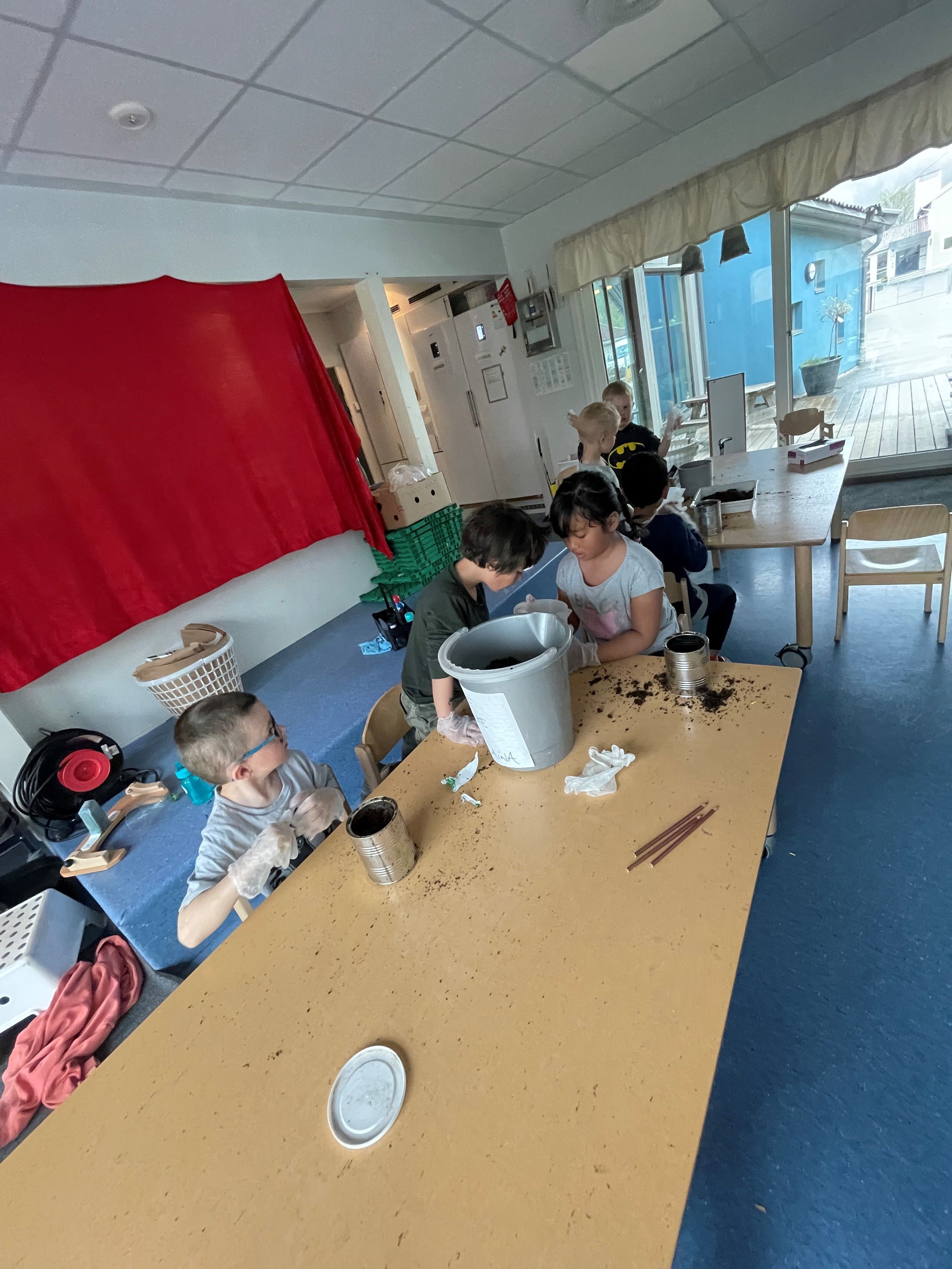
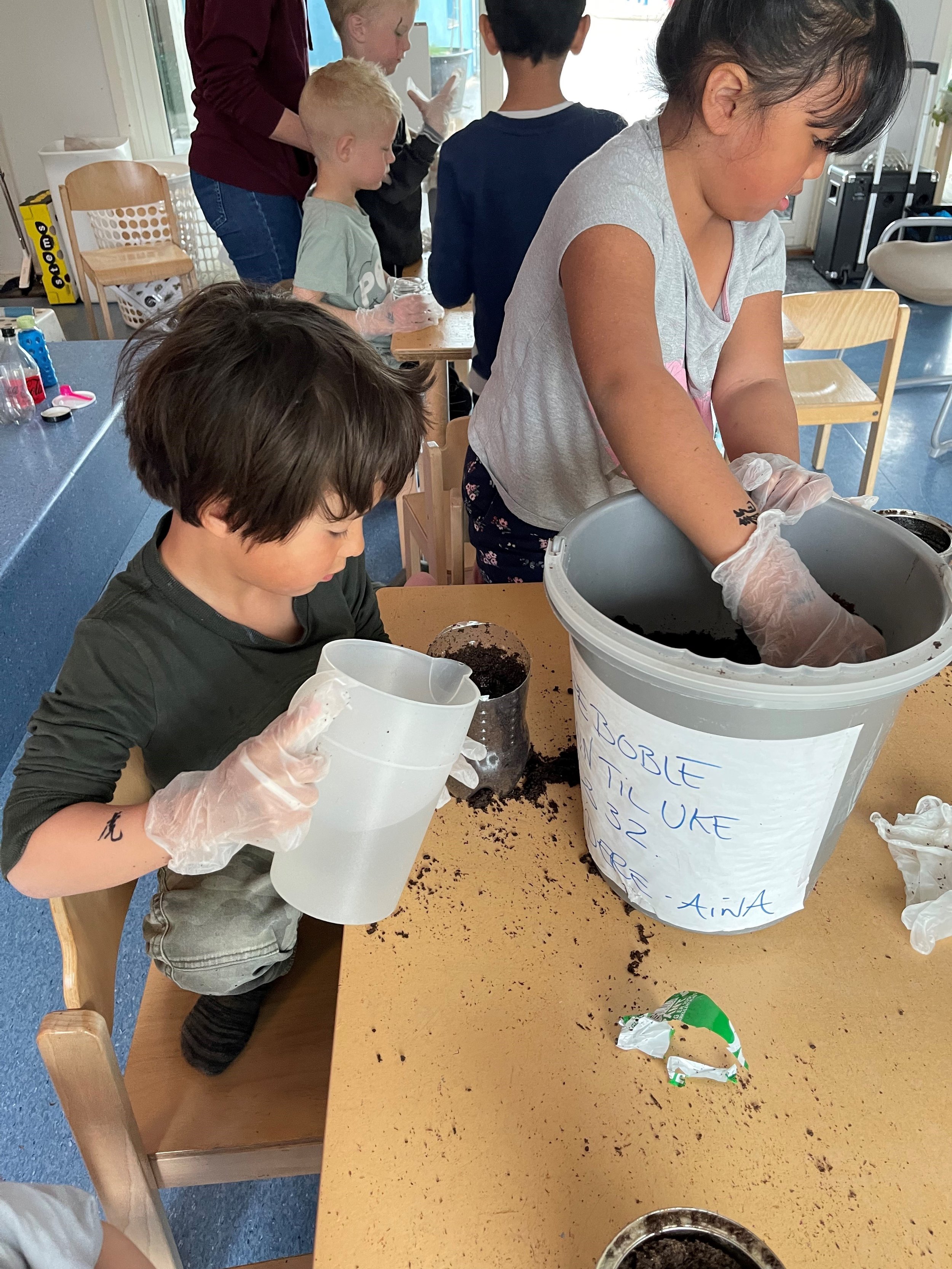
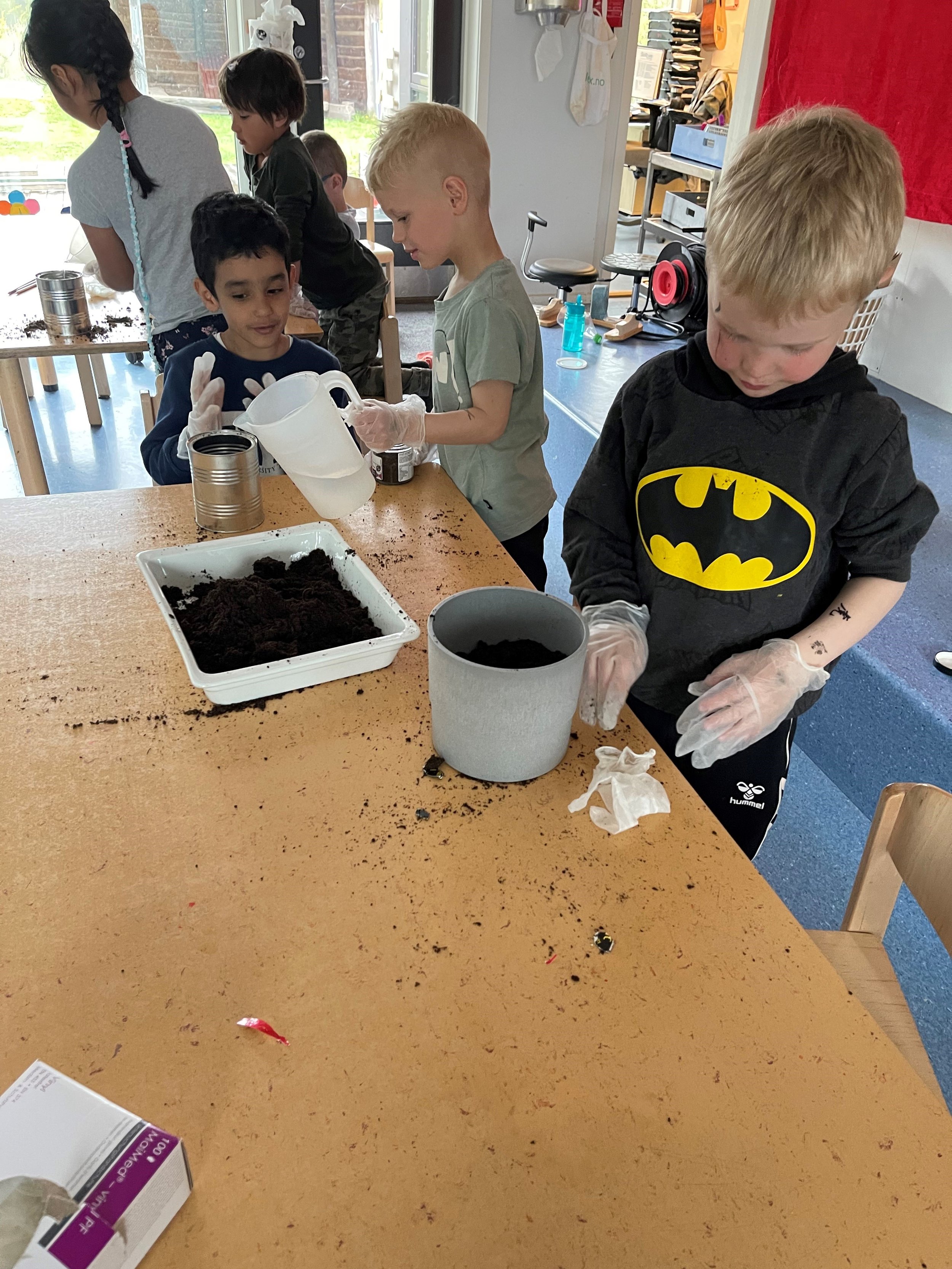
Through their Alcoa W5 project ‘Plant Without Borders’, both schools wanted to engage their students in their environment through planting vegetables and caring for a garden of their own. The project was also an opportunity to teach students about climate change and protecting biodiversity across two very different climates and countries.
10 teachers and 25 students are actively collaborating through digital tools and sharing platforms, where students share photos about the progress of their ongoing kitchen garden project. Students will meet virtually again twice before their garden tour and harvesting celebration in September.
And while a 6-hour time difference and very different climates may seem like a challenge, it's proven to be a wonderful opportunity for students to learn about how different seasons in different parts of the world impact the planting, growth and harvesting of vegetables.
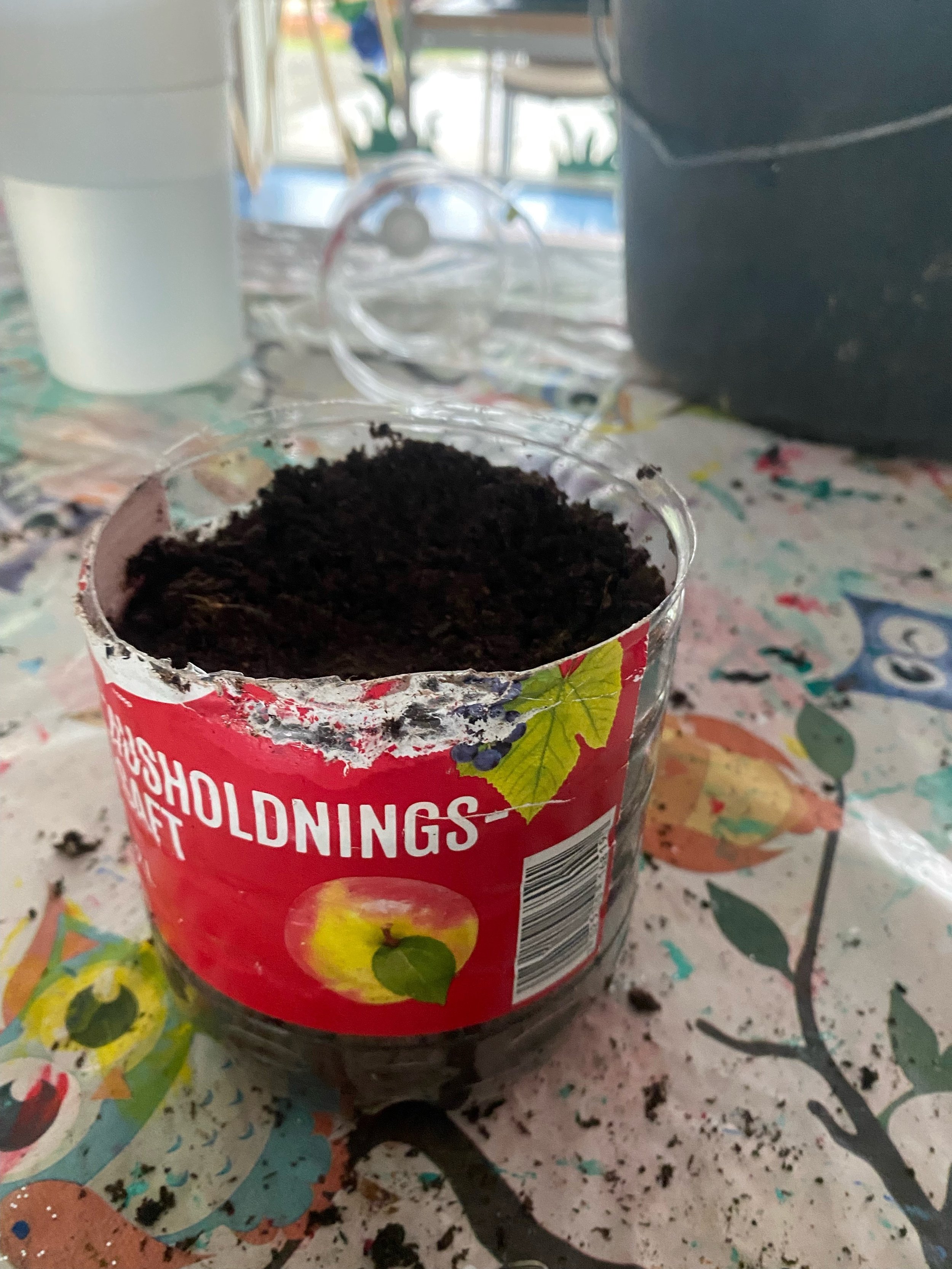
By creating pots out of recycled materials, planting both vegetables and native pollinator-friendly plants, and learning about climate change in group meetings, the project engages students in SDGs 4 (Quality Education), 12 (Responsible Consumption & Production), 13 (Climate Action), and 14 (Life on Land). Lastly, the experiences of both teachers and students in this project have been enriched through their collaboration. As Jan Rune Strømland, the Principal at Sentrum Preschool expressed,
“We are thankful for this opportunity to collaborate across country borders on a topic of high importance. The children will inherit the Earth, and it is our duty that they feel that they belong to nature and want to care for it. Through exchanging knowledge and experiences, we can help each other learn more about protecting biodiversity and sustainable development, and the children will hopefully grow an interest in plants and nature that can follow them throughout their lives.”

The Alcoa W5 project activities at Sentrum Preschool support the following SDGs:

Benefits of Outdoor Education
Perséides Elementary School, Canada
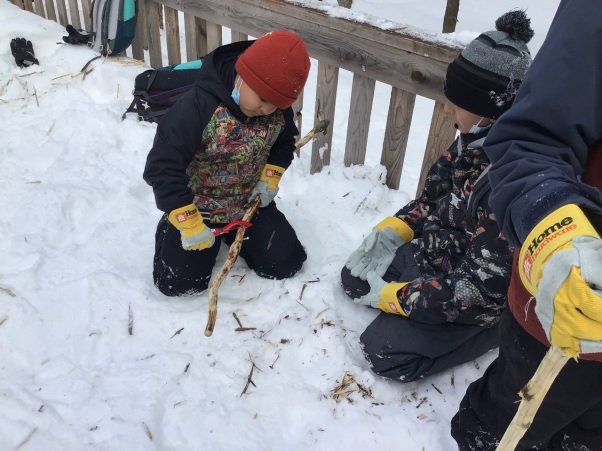
5 to 12-year-old students from the Perséides school of the city of Pointe-Calumet, located in the region of Quebec, Canada, took part in the W5 project and started using nature as a classroom!
The students at Perséides had expressed an interest in spending more time outdoors and the teachers quickly came on board and started finding creative ways to teach different subjects outside.
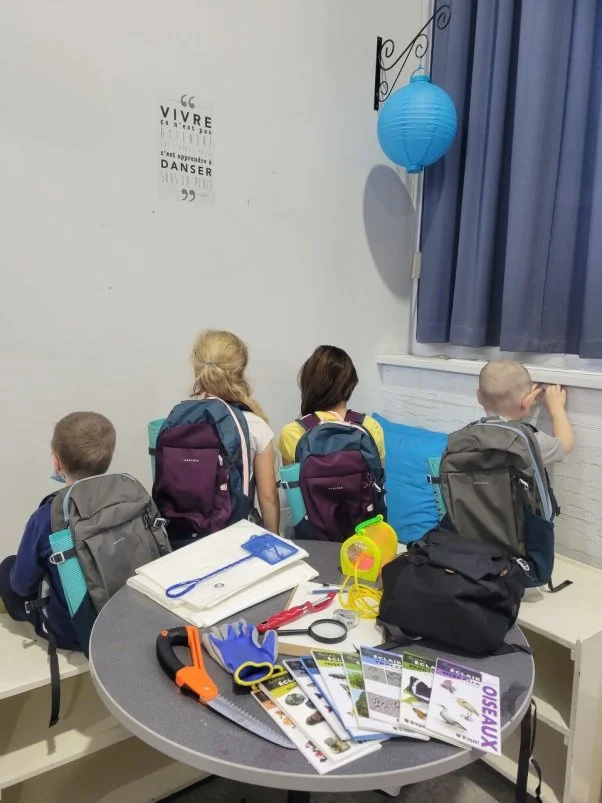
Each of the eight classes of the school benefited in different ways from the project. One class made art by drawing the trees and surrounding flora while others used the flora to learn about polygons. Small catapults were built with materials found outside to explore concepts linked to physics. Other classes learnt about the history of Iroquoian life (hunting, fishing, shelter building, bartering, etc.) as well as the Industrial Revolution by physically moving from a field to a more populated area with huts. In short, every reason was used to go outside, learn, and enjoy nature – in all kinds of weather.
"It’s amazing for me to work in the nature with my students! Lately we have been working on observing nature in order to reproduce it in art and we have been practicing math by calculating the perimeter of our snow fortress with tape measures.” - Cassandra Chenard, Teacher at the Perséides school.
The school used the funds of the Alcoa W5 project to buy equipment for outdoor observation and exploration. A group of dedicated parents helped the school with the management of the funds and the learning activities.
"To hear and see the students engaging in their outdoor learning is simply amazing. As parents, we realise how useful these hands-on activities are. They understand different concepts in a much better way. Moreover, we are seeing that they now want to observe and protect the nature more at home.” - Anik Rochat, parent of four students at the Perséides school.
Exploring nature with appropriate equipment has created a real increase in student motivation and engagement in their learning. Retention of information is stronger when students have experienced their learning and it is therefore more concrete and meaningful to them. A reduction in stress was also noticeable for several students. This project is now embedded in the students' weekly learning!



The Alcoa W5 project activities at Perséides alternative school support the following SDGs:

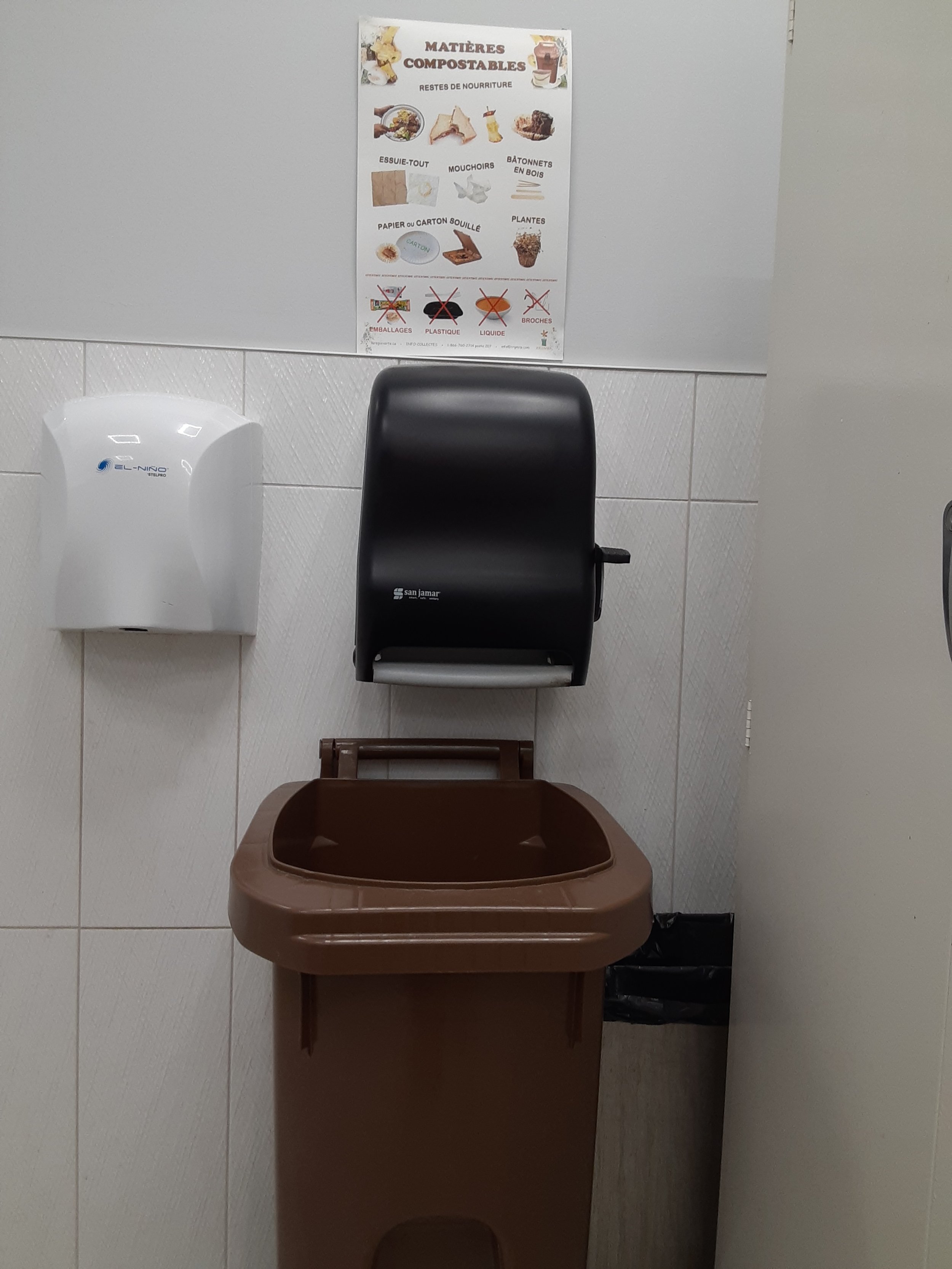
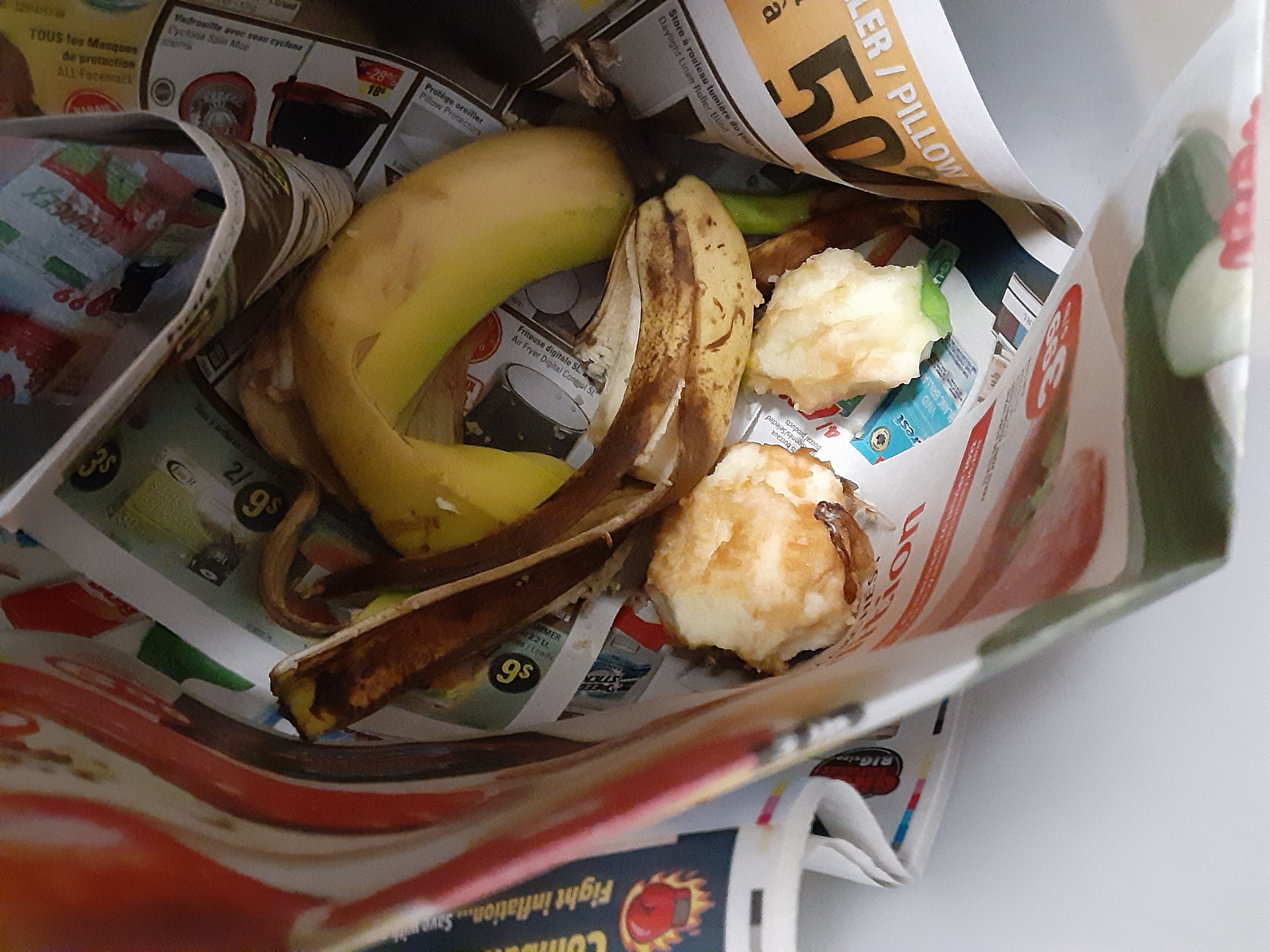
“Who put a mask in the compost bin?”
Perce-Neige Elementary School, Canada
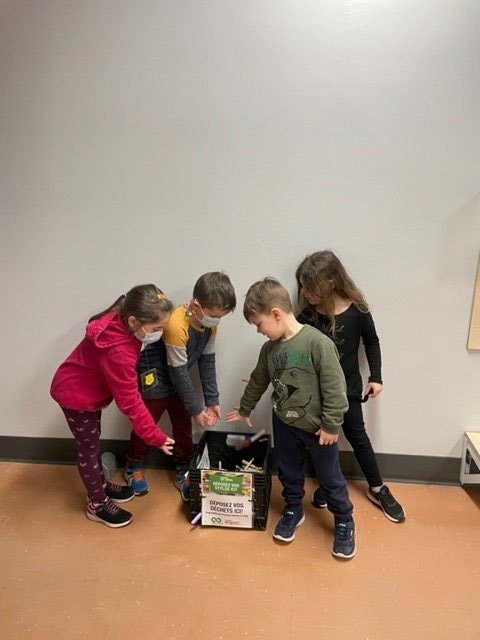
5 to 12-year-old students from the Perce-Neige school of the city of Pierrefonds, located in the region of Quebec, Canada, took part in the W5 project with the objective of improving recycling and composting within their school.
When returning to school after the COVID-19 lock-down, the teachers and students wanted to revive good recycling and composting practices at the school. They had observed that some students were putting everything in the green bins and therefore wanted to make everyone more aware of their daily waste production, to understand the recycling systems, and to act more responsibly.
To start off the project, the school contacted the Regie régionale de gestion des matières résiduelles de Portneuf - RRGMRP (the municipal organisation that manages the residual waste of 23 municipalities). RRGMRP helped install waste recycling stations throughout the school and conducted a number of workshops to promote waste reduction at source, improve the waste management, and to explain how waste is connected to CO2 emissions.
Posters were made by the children to help staff and students understand how to sort their waste. Their sorting skills was put to the test during a Community Action Day when all students, along with their friends and families, were invited to do a litter-pick around the school and to dispose of the waste in the right bins.
"Who put a mask in the compost bin?” - Student from the Green Squad.
The project helped students gain more confidence and a sense of responsibility by empowering them individually and collectively. Staff and students improved their knowledge of the different waste items that can be recycled, such as paper, cardboard, plastic, metal, glass, and organic materials, thanks to the standards provided by the RRGMRP and the awareness raising activities.
In collaboration with the RRGMRP, the school will compare the tonnes of general waste, recyclable, and compostable materials collected between September 2021 and June 2022. This will give them a clear idea of the CO2 produced and the materials diverted from the landfill – setting a baseline that can be improved even more in the future.

The Alcoa W5 project activities at Perce-Neige school support the following SDGs:
Creating Outdoor Learning Opportunities
La Saumonière Preschool, Canada
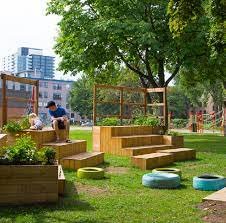
Through the W5 project, preschoolers from La Saumonière school of the city of Donnacona, located in the region of Quebec, Canada, had the chance to build a school garden and learn how to grow their own fruits and vegetables.
As the school courtyard was planned to be redesigned by spring, the teachers thought it would be a great opportunity to add a garden section and different fruit trees. By making these new outdoor spaces, they wanted the children to learn how to grow fruits and vegetables and to understand the importance of taking care of their environment. It was also an opportunity to teach them basic concepts connected to ecosystems and biodiversity through hands-on activities.
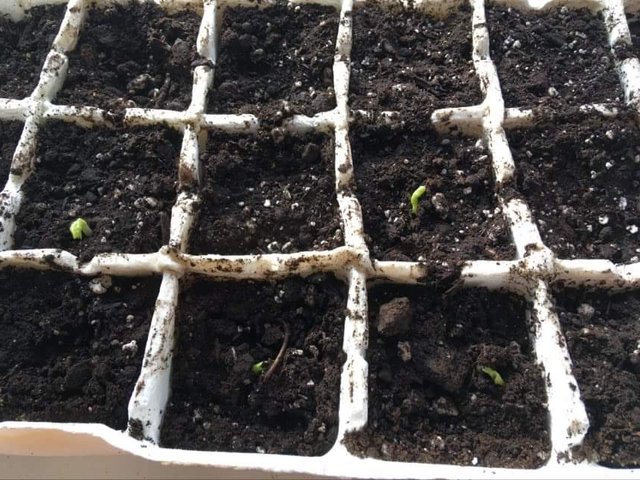
First, a presentation of the project was made to the school board and a few meetings about the redesigning were held. The teachers then researched materials and developed a plan together with parents and Alcoa volunteers. Even before the garden was ready, the teachers introduced the children to gardening concepts and helped them grow plant seedlings.
“I’m really excited about making the school courtyard greener! I can already see the children very interested about the growth of their plants and coming to me during the break to tell me about it! They will see that they can make an impact through their consumption and will understand how important it is to avoid food waste. “ - Mélanie D’Anjou, La Saumonière school.
Through this project, the school hopes to strengthen their collaboration with the local community by offering part of their harvest to community members who, in return, can help take care of the garden during school vacations.
Thanks to W5, the children were introduced to concepts of responsible consumption and production and have improved their healthy eating habits. Moreover, the children have benefited a lot from working in small groups to build something useful for the community. The school also saw this as an opportunity to integrate more environmental topics into their curriculum, including food provenance and plant growing.
The Alcoa W5 project activities at Curé-Brassard school support the following SDGs:

Using Creativity to Raise Awareness
Curé-Brassard Elementary School, Canada
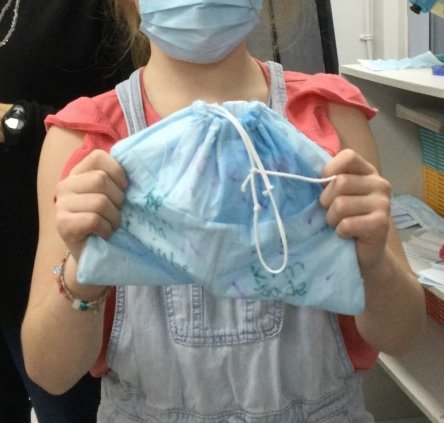
8 to 10-year-old students from the Curé-Brassard school of the city of Nicolet, located in the region of Quebec, Canada, took part in the W5 project with the objective of improving their upcycling skills by creating second-hand bags from COVID-19 masks. The goal was also to raise awareness about the litter created by human activity and to exchange knowledge across generations.
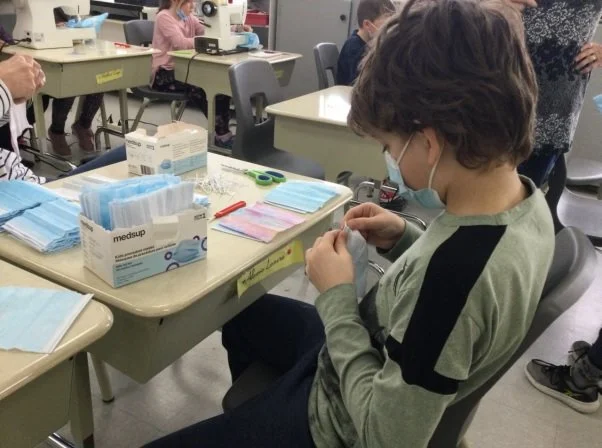
With more than 1000 masks used per day, the school raised a global concern about the amount of COVID-19 waste in their bins. The education team wanted to give students the opportunity to learn how to recycle and create second-hand items. Moreover, this project allowed them to teach children how to sew and be creative!
How did they do it? The team contacted people in the local community and presented the project to the board and the council of the school. They even met the city councillors to make them commit to the work. In order to engage a few elderly people to join the kids, the school also contacted the director of a local community centre for elderly.
“We asked all our colleagues to help us with the collection of used masks. We tested the fabric, washed them, and tried to create a prototype of a grocery bag with the collected waste. Since October, the children have been meeting once a week to prepare and create the bags. We also solicited the help of elderly people for their sewing skills, and we wanted them to socialise with the younger members of the community.“ – Elisabeth Cassan and Gaétane Fortin, the Curé-Brassard school.
Thanks to the W5 project, the children have developed important creative skills, they have helped the school and community reduce their waste, and they have gained important social skills! The plan is to sell the bags and use the profits for having an outdoor class.
Éloise felt very proud the first time she completed her first sewing project. Moreover, she was the first one to finish it! She called her grandmother to tell her all about this experience. Éloise became very independent in the course of a few weeks. She now knows how to cut masks and remove bands as well as metal pieces. She is now also able to give advice to her classmates and help them in complicated sewing situations.“ – The story of 9-year-old Éloise, student at the Curé-Brassard school.
Radio Canada even published an article about this school's innovative recycling project which recognizes the school's environmental efforts in their community: https://ici.radio-canada.ca/nouvelle/1877584/recyclage-masques-jetables-ecole-cure-brassard



The Alcoa W5 project activities at Curé-Brassard school support the following SDGs:

From Plastic Bottle Caps to an Outdoor Classroom
Tecumseh High School, USA
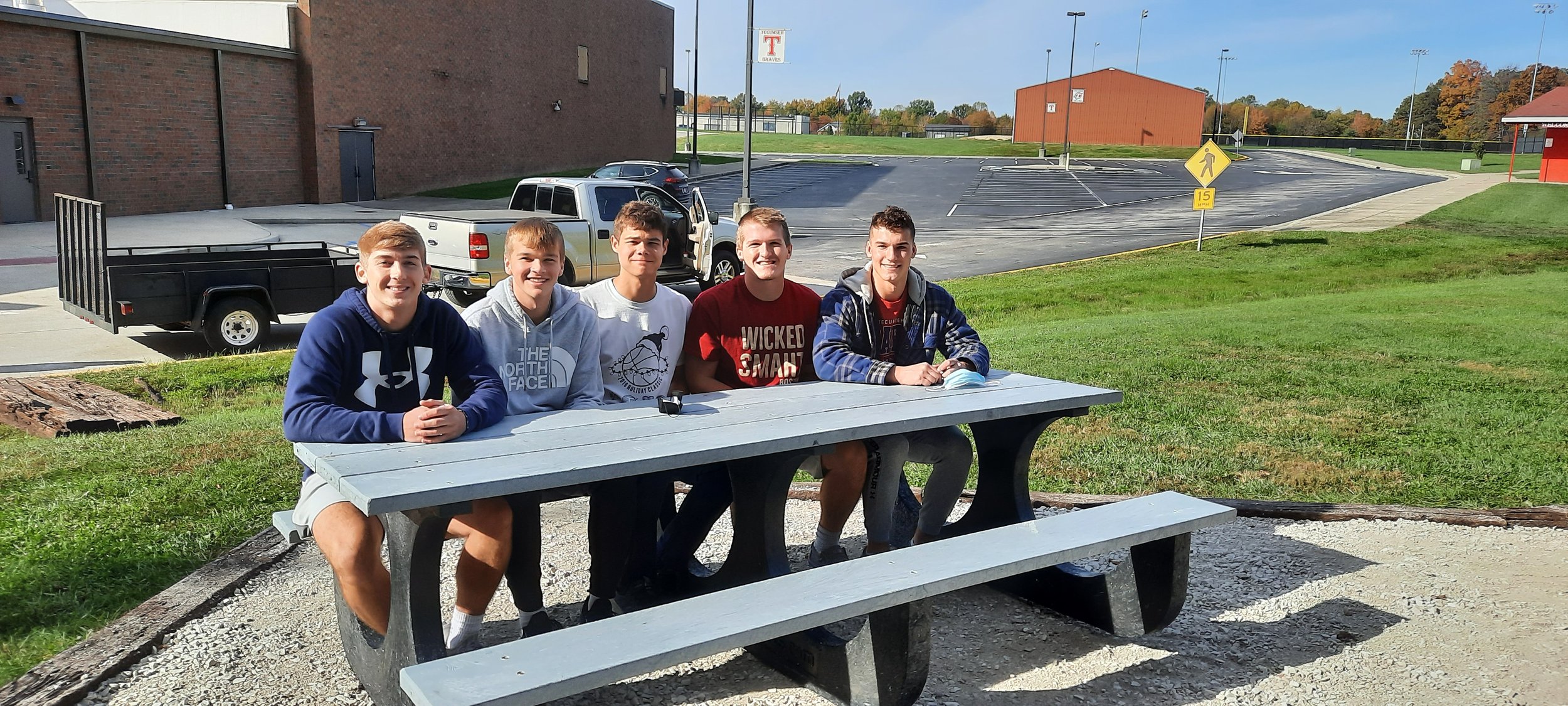
Through the Alcoa W5 project, students from the Tecumseh High School in the USA decided to fundraise, recycle, and collaborate to build an outdoor learning space for the whole school to use!
The idea for the outdoor classroom came about when the school found a source with over 5000 pounds (over 2200 kg!) of bottle caps. After some discussion, it was decided to recycle the lids and kickstart the construction of a learning space outside. First, students gathered, sorted, and packaged all the plastic lids and took them to a recycling plant in exchange for five picnic tables. This activity created awareness of the importance of recycling and the students saw with their own eyes the amount of litter in their local environment.
“Sorting bottle caps was simply gross. And monotonous. And time consuming. But the kids stuck with it, and now they want to start a plastic bottle recycling program at our school!” - Kori Kutzler, Tecumseh High School
But it didn’t end there! The school sent 90 letters out to their local community asking for donations to support the project. The students put a lot of time into writing the letters, and each time they received money, they were thrilled and honoured! They realized how much support they had, and it inspired them to work harder.
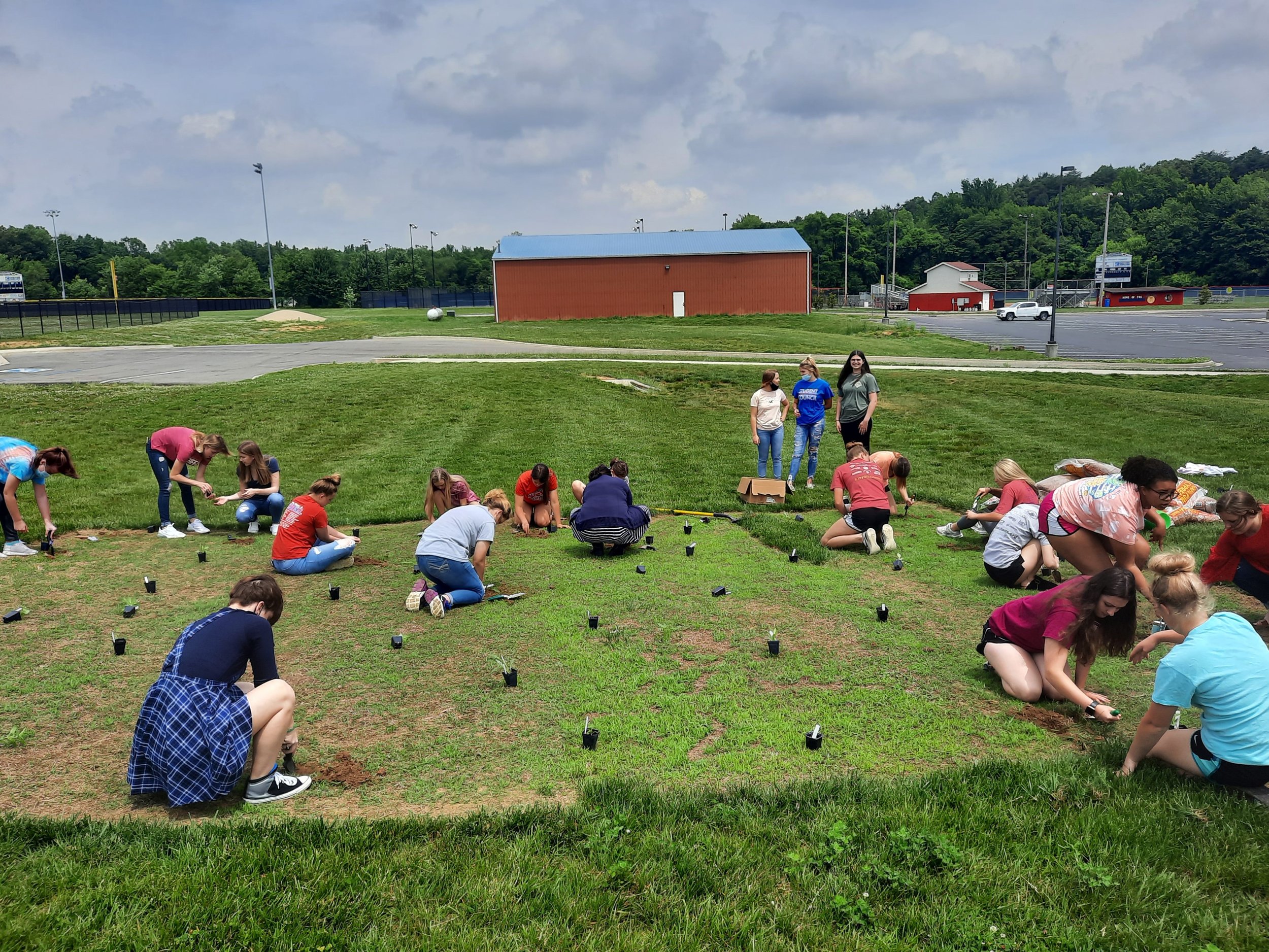
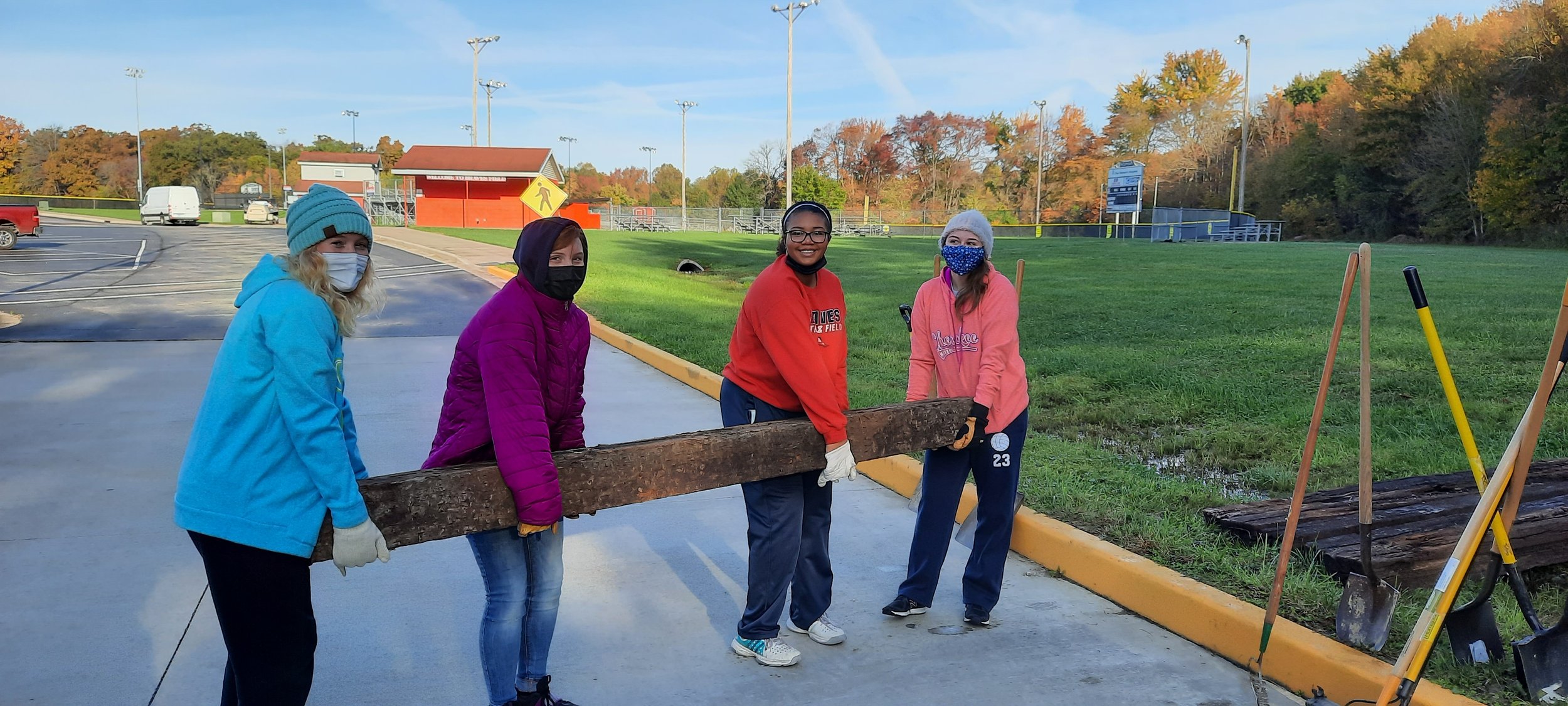
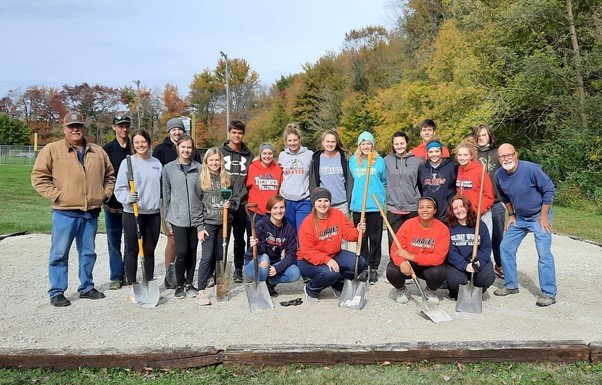
With the help of parents, community members, and the school corporation’s maintenance team, two Community Action Days were spent building the outdoor classroom. They lined the allocated area and secured it with railroad ties, added gravel across the entire area, and set up the picnic tables. They also created a path through the nearby woods and installed a bridge to allow access over a drainage ditch.
“It has been amazing to see all the caps recycled and turned into tables. We are so proud to have an outdoor classroom and path through our woods that came from such hard work. We worked all school year for this, and now the whole school can enjoy the space.” Payge Johnson – student, Tecumseh High School
With this project, students spent a lot of time outside whether it was during litter-picks or the construction of the outdoor area. They saw first-hand the power of reusing instead of creating waste. By collaboration with different organisations and experts, they also learned about natural irrigation, native and invasive species, and habitat restoration.
The Alcoa W5 project of Tecumseh High School support the following SDGs:

Addressing SDG 12 at School
Grande-Vallée Elementary School, Canada
Primary students from the Grande-Vallée school in the city of Marguerite d’Youvill, Canada, have exciting plans this year. As part of their W5 engagement, they decided to organise an “Earth Week” for the whole school to address a range of issues connected to the Waste theme.
When brainstorming about what to improve in the school, the student members of the school’s Eco-Committee “Ecol’eau Club” pointed out that the area surrounding the facility was not always clean. They had noticed that litter, including used masks, was left on their playground. To tackle this problem, the committee decided to organise a Spring-Cleaning Day which would involve every member of the school and raise awareness among students, teachers, staff, and even parents.
This Spring-Cleaning Day will form part of an even bigger event at the school: “Earth Week” – starting on the 18th of April. This week will be completely dedicated to the environment and will include several activities related to recycling, zero-waste, and sustainable use of energy. With funds from the Alcoa Foundation, the school plans to buy tools for the cleaning day as well as relevant educational materials to ensure that learning also takes place as part of the activities.
Grande-Vallée school is focusing on SDG 12 - Responsible Consumption and Production in particular. Students will learn about waste prevention and recycling, sustainable management of natural resources, and what a sustainable lifestyle looks like in practice. By participating in the planning of these activities, students get a taste of the leadership, organisation, and advocacy skills needed to help achieve SDG 12.
“This project has been an extremely rewarding experience for our young Eco-Students. In addition to all the environmental knowledge acquired and skills developed along the way, we can clearly see some gains in the children that we had not thought of at first. Indeed, it is with great joy that we have noticed that many of our students have gained a stronger sense of belonging to the school, increased self-confidence, and a newfound pride.” – Amélie Marois and Julie Vézina, teachers from Grande-Vallée school
During the big Spring-Cleaning Day, more than 10,000 square meters of land around the school will be cleaned and more than 1200 people, including parents, will learn about the importance of avoiding litter and pollution, producing as little waste as possible, reusing and recycling waste, and saving energy.

The Alcoa W5 project activities at Grande-Vallée school support the following SDGs:
Let’s Leave the Screen Inside
Du Phare Pre- and Elementary School, Canada
Pre-school to 6th grade students from the Du Phare school of the city of Deschambault, located in the region of Quebec, Canada, took part in the W5 project with the objective of spending more time outdoors, reducing the use of electronic tools, and learning about biodiversity.
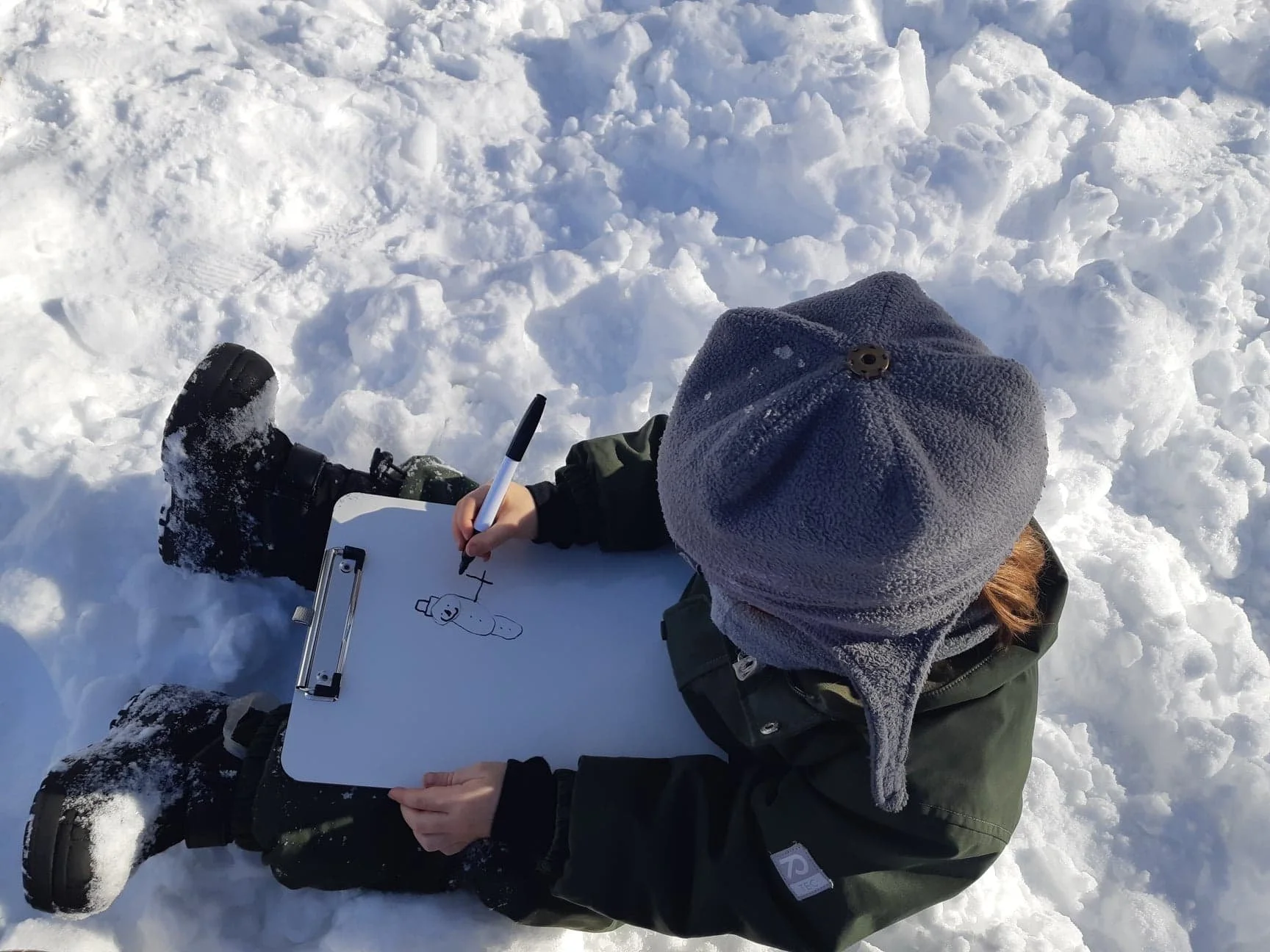
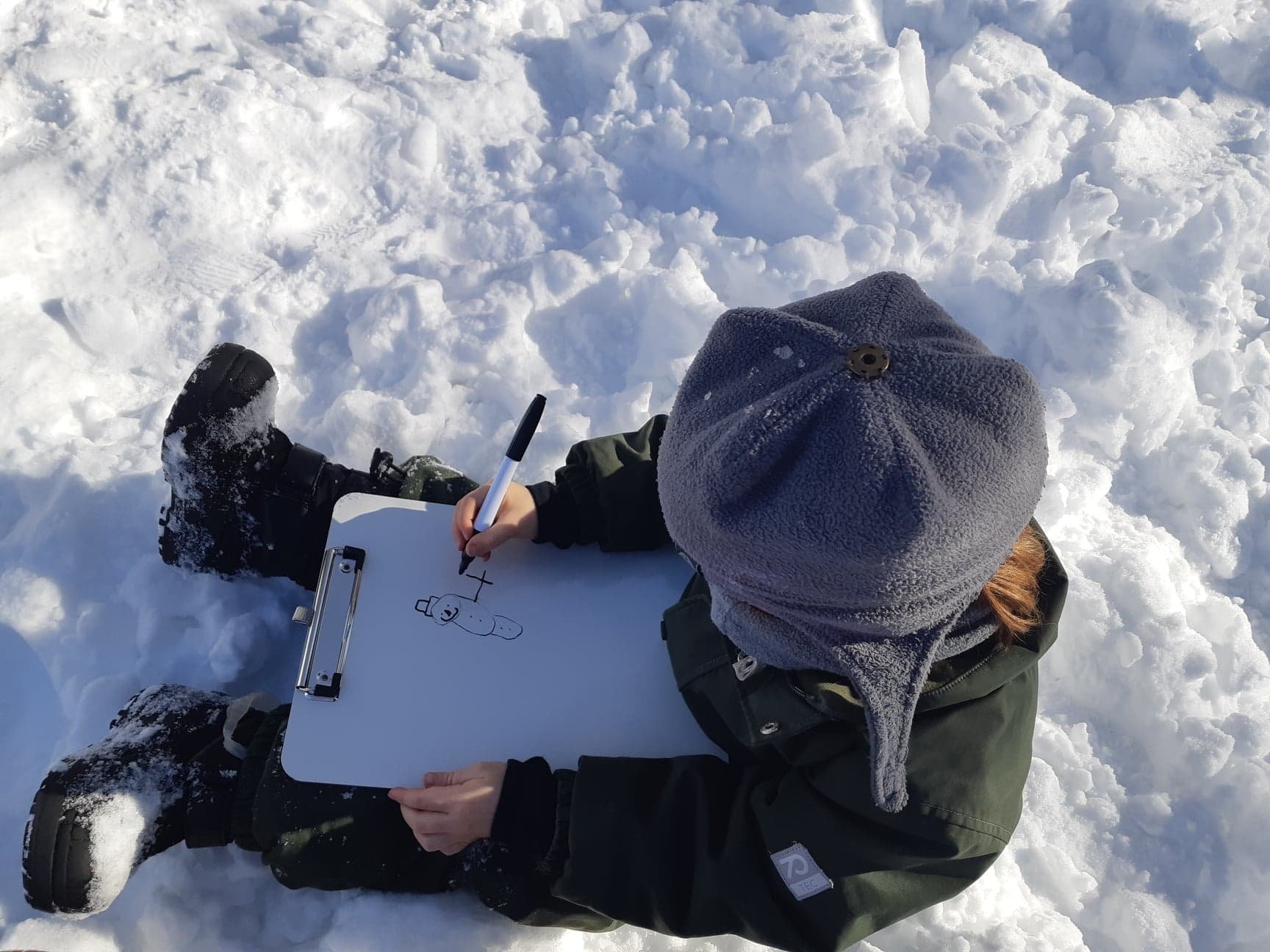
The school already had a furnished outdoor classroom, but it was rarely used. After consulting teachers and students, they decided to invest in teaching and utility materials, such magnifying glasses, birdhouses, small dry erase boards, nature books, seeds, plants, carts, and floor cushions – in order to enhance the outdoor classroom conditions and encourage everyone to spend more time outside.
"Our aim was to get students out of the classroom, without screens, and to focus on themselves, nature, and how to take action for the environment. Thanks to Alcoa's support, we were able to purchase 60 cushions and 60 dry erase boards, as well as scientific observation tools which will allow three classes to go outside to learn simultaneously. Thank you for allowing us to enjoy the outdoors more often!" - Anna, Charlotte, Claire, Clémence, and Léa, student members of the Eco-Committee at Du Phare school
Outdoor Education is a significant contributor to the Sustainable Development Goal 3 - Good Health and Well-Being as it is scientifically proven that spending more time outside in a natural environment can help reduce stress, improve self-esteem, and increase feelings of happiness. Moreover, multiple studies strongly suggest that contact with nature enhances academic performance, personal development, and pro-environmental attitudes.
As part of the W5 project, the school also installed bird feeders and nesting boxes in the school yard and created a pollinator garden so students could observe and monitor the animal, insect, and plant species surrounding them. With help from volunteers, the Eco-Committee organised a Spring-Cleaning Day for the whole school in order to remove weeds and trash from around the facility and to raise awareness about the amount of waste left in nature.
"As a principal, I could only support the Eco-Committee’s actions, knowing how much the environment concerns our youth. The members of the committee are working to mobilize other students and staff to respect the environment. In this context, the idea of using our outdoor classroom came up. With the financial support, we were able to purchase what we needed to make the most of the nature classroom and capture the interest of our students. A beautiful project piloted with a masterful hand by a committed teacher!" - Nathalie Morin, Principal of Du Phare School


The Alcoa W5 project activities at Du Phare School support the following SDGs:
Clean Waterways Are Vital
Sainte-Anne Pre- and Elementary School, Canada
For the week of Earth Day (April 22), students from Collège Sainte-Anne in Dorval, Canada are busy organising a clean-up of the river Ruisseau Bouchard, which they adopted last year in collaboration with The Water Education and Eco-Monitoring Group (G3E).
A total of 22 classes from Preschool to Grade 6 will be invited to clean the banks of Bouchard Creek and its watershed during the week of Earth Day. The goal is to allow the native fauna and flora to regain their rights on the stream – and to learn about the importance of clean waterways. To have an even greater impact, the City of Dorval, GRAME and city residents will also be invited to do their part!
“I would like to thank the Alcoa Foundation for their support in this action! Thanks to them, we have more resources to take care of our waterways.” - Aline Boisjoli, Teacher responsible for green projects.
In the photos, students are harvesting macroinvertebrates and collecting data that will help them understand the health of the stream and how to improve it.


The Alcoa W5 project activities at Collège Sainte-Anne support the following SDGs:


Tree Planting Is Not Only About Planting Trees
Castle North Middle School, USA
As part of the Alcoa W5 project this year, the Green Team at Castle North Middle School in the USA chose to focus on two themes: Waste and Wildlife. Addressing the Wildlife (or Biodiversity) theme, the students decided to collaborate with The Warrick County Soil and Water Conservation District (SWCD) in order to learn about native and invasive species on their school grounds as well as the best ways to transport at and plant new trees. A good example of Environmental Education in action!
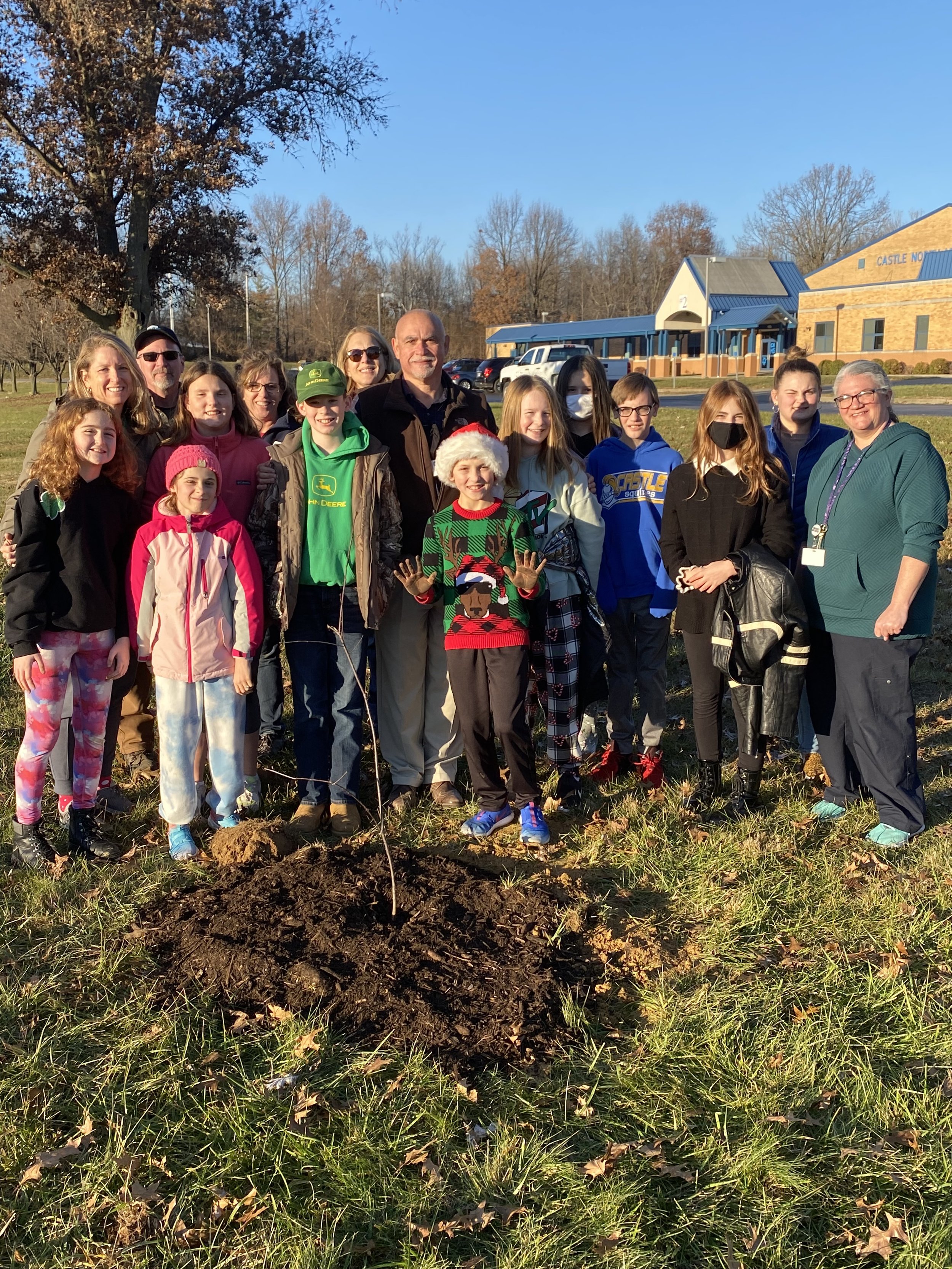
The Green Team worked together with SWCD representatives to remove Bradford Pear trees (an invasive species) and replace them with two Red Oak saplings at the front of the school. Oak trees were chosen because they are a source of acorns, a very nutrient rich food for wildlife, unlike the Bradford Pear trees they replaced. The goal of planting these trees was to promote biodiversity and give indigenous plants more room to grow. Only hand tools were used for the planting and the children were allowed to get involved in the manual labor of the planting.
Susan King, the office manager of the SWCD, explained their reasoning for the collaboration:
“The kids are the future of wildlife conservation, and it is important that we keep educating kids and help them find an interest in preserving nature.”
Representatives of the SWCD explained the way that they plant trees and the new system in place for transporting them. The trees planted at Castle North Middle School have a new patented method for growing saplings before planting: they are put into a plastic sleeve that wraps around the tree to help the roots grow vertically rather than tangled up in a bag. They are also easier to remove as there is simply a zip tie holding the sleeve together. When it is removed, the entire sleeve is lifted off and the job is done.
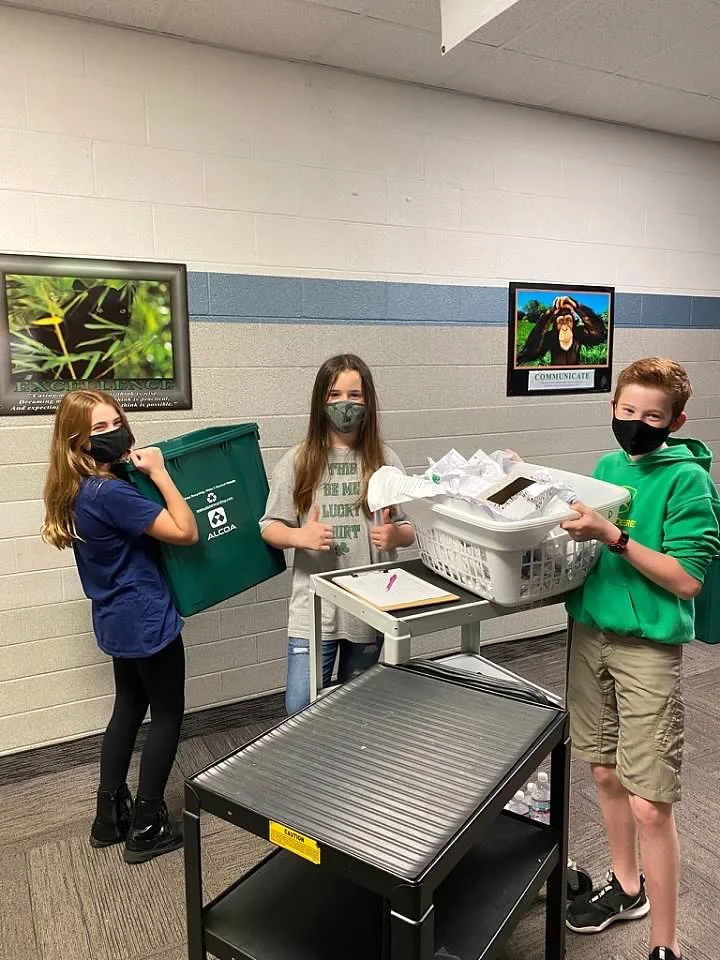
Addressing the theme of Waste, the Green Team at Castle North Middle School has also been hard at work after school two Wednesdays a month collecting the paper, plastic bottles, and aluminum cans to recycle from classrooms and around the school. All the full recycling bins are great proof that the awareness raising activities at the school are paying off! The recycling bins were purchased with the assistance from the National Wildlife Federation and support from the Alcoa Foundation.

The Alcoa W5 project activities at Castle North Middle School support the following SDGs: