E-SPACE
Eco-Schools Project Advancing the Circular Economy (E-SPACE)
Eco-Schools Project Advancing Circular Economy (E-SPACE) aims to prepare the younger generation with the knowledge of the Circular Economy and to empower them to take actions for advancing circular economy.
E-SPACE started as a pilot project in the Eco-Schools of Slovenia and Latvia with support from LUCART Professional in the year 2019. After a successful pilot, E-SPACE was selected by Pratt & Whitney and the North American Association for Environmental Education (NAAEE) as a winner of the first-ever Pratt & Whitney Global E-STEM Awards. The prize will help FEE to expand the initial pilot project to 80 schools in eight countries in South America, Africa, Europe and Asia.
Circular Economy as a perspective is built on the natural world where there is no concept of waste, and everything is a resource for the next level step in the cycle of dependence.
E-SPACE is an attempt to capture the concept of Circular Economy and present it to the stakeholders in the school system for education to develop the literacy that will help in advancing the demand for circular economy.
Resources
Curricular Framework for Advancing Circular Economy
The framework is intended to support curricular developers in integrating concepts linked to Circular Economy into teaching, including in the educational standards that guide the curriculum and in the content used to engage educators and students in the classroom and beyond.
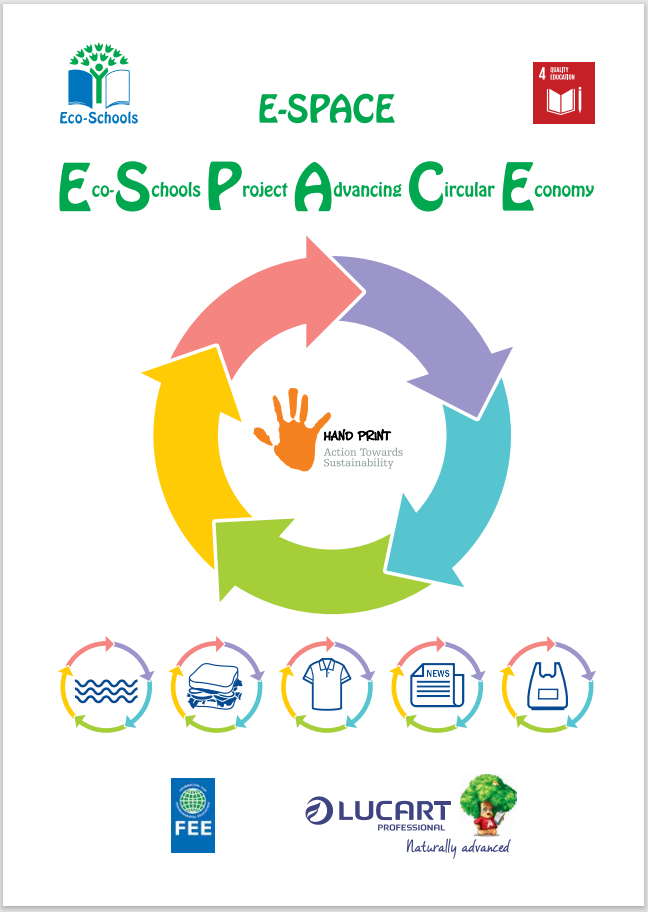
Lesson Plans on Circular Economy
The entry point to circular economy education can be through any existing environmental education initiative like energy conservation, waste management, biodiversity education, climate change etc. with focus on reducing waste. The literacy should motivate a person with competence to reduce the loss of material and energy at every stage of production and consumption through product and service redesign.
Download the full set of lesson plans in English, French, Spanish, Latvian and Slovenian.
What is Circular Economy?
Moving from Linear to Circular Economy

Circular economy is based on three main principles:
“designing out” waste or simply rework the systems to not produce waste. This is achieved by design of product or services that are durable, uses recyclable material, and are repairable;
separating the biological (residual resources that are non-toxic and can be safely returned to the biosphere often organic like paper and wood) from technical (unsuitable for biosphere systems like metals and plastics) nutrients where the former are returned back to the biosphere, and the latter are reused indefinitely. This requires our participation for example in the segregation of waste at home and composting green waste and putting other waste for recycling;
using renewable energy to decrease dependence on coal and other fossil fuels and reduce loss and vulnerabilities to failure by producing locally.
Download the poster in English, French, Spanish, Latvian and Slovenian.
For more information about this publication, please contact Pramod Kumar Sharma.
Key Literacy Outcomes

Take actions that reduces consumption
Take actions that support resilience of Earth Systems
Take actions for waste minimization
Support sustainable products and services as a consumer
Increase awareness of actions that supports sustainability
Advancing Circular Economy of Paper
Paper is an excellent example to see the strategies that can be adopted for increasing Circularity. The core idea is to see that there is no waste!


